Application Guide · Duplex Polarity

A-to-B vs A-to-A Patch Cord: Choosing LC Duplex Polarity

The A-to-B vs A-to-A patch cord choice is easy in most networks: order A-to-B. ANSI/TIA-568.3-E treats A-to-B as the standard duplex patch cord, because it carries the transmit fiber at one end to the receive position at the other. A-to-A cords keep A on A and B on B; the standard uses them only in one place, at one end of a Method A channel built on MPO trunks and cassettes. This guide explains both cord types, the polarity methods behind them, how to check a cord with a light source, how to reverse an LC duplex or uniboot cord safely, and how to write polarity on an order.

Published 2026-11-10 · Updated 2026-11-10 · By the Lumafyn Technical Team

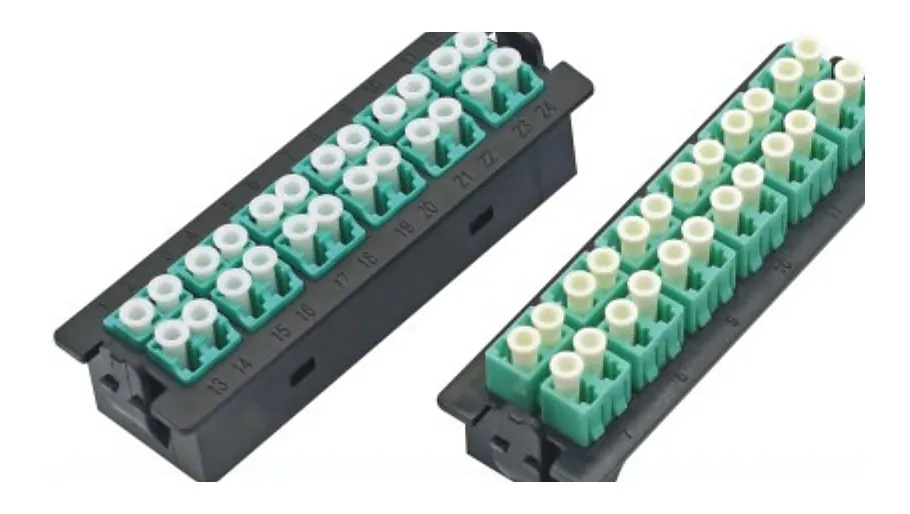
High-density fiber patch panel with LC adapters

What A and B Mean on a Duplex Connector

A duplex connector, such as an LC duplex or an LC uniboot, holds two fibers side by side. The two positions are labeled A and B. In every working duplex link, the transmitter at one end must reach the receiver at the other; Fluke Networks states the rule simply: in a duplex channel, Tx should always connect to Rx, regardless of the number of patch panel adapters or cable segments.

A-to-B and A-to-A duplex patch cords
PointA-to-B cordA-to-A cord
Fiber pathPosition A at one end goes to position B at the otherPosition A goes to position A, B to B
Role in TIA-568.3-EStandard duplex patch cordUsed only where a polarity method needs it (Method A, one end)
Typical useSwitch to panel, panel to panel, switch to switchOne end of an MPO Method A channel
Names you may see"Crossover", "standard", "A-B""Straight", "A-A"
Risk if used in the wrong placeNone in standard linksTx meets Tx; the link stays down

Be careful with the words "straight" and "crossover". Vendors use them in opposite senses: some call A-to-B a crossover because the fibers swap positions, while Fluke Networks describes an A-B cord as providing a straight-through connection in the polarity sense. On an order, write "A-to-B" or "A-to-A" and avoid the other terms.
Patch cords are only part of the channel. TIA-568.3-E describes two ways to build duplex permanent links (for example LC-to-LC panels joined by a multi-fiber cable) so that standard A-to-B cords work at both ends:

  • Consecutive-fiber positioning. Adapters are installed in opposite orientations at the two ends (A-B at one end, B-A at the other) and fibers are terminated in the same order, 1, 2, 3, 4, at both ends.
  • Reverse-pair positioning. Adapters face the same way at both ends, and fibers are terminated 1, 2, 3, 4 at one end and 2, 1, 4, 3 at the other.

Either method gives a permanent link that behaves like a crossover, so A-to-B cords at each end complete a correct channel. When a site has no record of which method was used, a polarity test of the permanent link tells you before cords are ordered.

Duplex Polarity Over MPO Trunks

Many data center links run LC cords into cassettes that sit on MPO trunks. Here the trunk type and the cassette decide which cords you need. The table follows the TIA-568.3-E summary published by the TIA Fiber Optics Tech Consortium.

Duplex patch cords per TIA-568.3-E array polarity method
MethodTrunkCassette / adaptersDuplex cords
AType A (straight)Type A transitions, key-up to key-down adaptersA-to-B at one end, A-to-A at the other
BType B (reversed)Type A transitions, key-up to key-up adaptersA-to-B at both ends
CType C (pair-flipped)Type A transitions, key-up to key-down adaptersA-to-B at both ends
U1 / U2 (added in 2022)Type B (reversed)Type U1 or U2 transitionsA-to-B at both ends

So A-to-A cords appear in one method only. If your site is Method A, label the A-to-A end clearly and keep those cords on a separate shelf. If you are designing a new channel, a method that uses A-to-B cords at both ends removes the question altogether. For the trunk side of these methods see our MTP/MPO polarity guide.

How to Check Which Cord You Have

  1. Read the label. Many cords carry A and B marks on the duplex clip or on the boot. Labels can be wrong, so test anything that matters.
  2. Use a visual fault locator. Connect a red-light source to the fiber in position A at one end. At the far end, see which connector glows. If it is B, the cord is A-to-B; if it is A, the cord is A-to-A.
  3. Test channels, not just cords. A polarity test of the full channel, including panels and cassettes, confirms that Tx reaches Rx before optics are connected.
  4. Record the result. Note the cord type against the port map so the next change uses the same part.
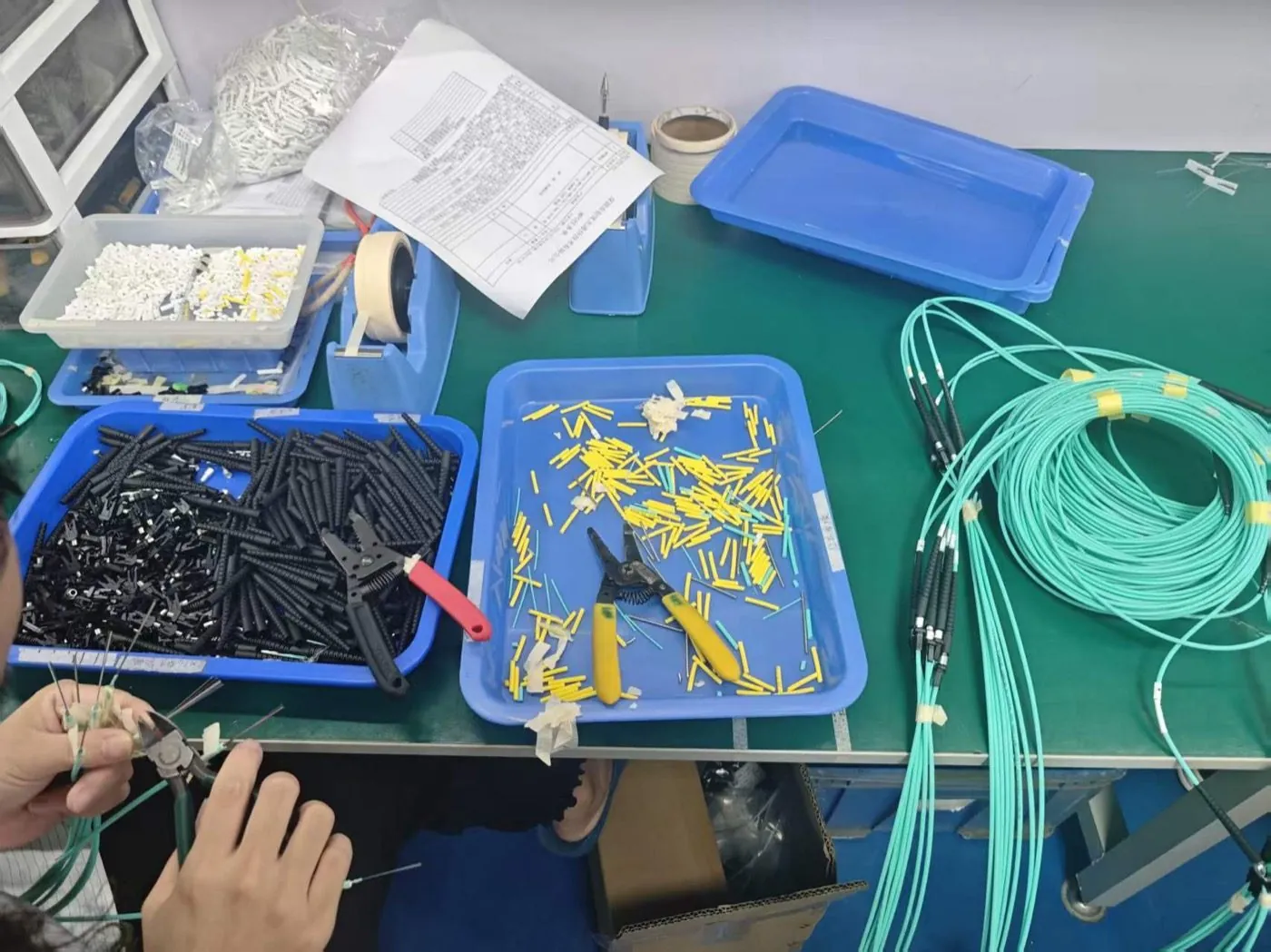
Hands assembling fiber connectors at a workbench, with blue trays of black and yellow connector parts and coils of aqua patch cord

On cords made in our own factory, polarity is set when the duplex clip or uniboot body is assembled, and the label records the type ordered.

Reversing Polarity on LC Duplex and Uniboot Cords

When a link fails because polarity is reversed, the fix should happen in one documented place, normally the equipment cord at one end.

  • Standard LC duplex with a clip. Remove the duplex clip, swap the two LC connectors, and refit the clip. Keep the fibers clean and do not pull on them.
  • LC uniboot. Many uniboot designs let the installer swap the two fibers without tools, by rotating the connectors or the latch in the boot. The method differs between designs, so follow the instructions for the model you have. See our LC uniboot patch cords for the options we quote.
  • Relabel. A reversed cord is now a different part; change its label so the record matches.

Avoid fixing polarity by turning adapters in a panel or swapping fibers in a cassette. It may bring one link up, but the panel no longer matches its drawing and the next technician inherits the problem.

Writing Polarity on a Duplex Cord Order

Put the polarity on every line, even when all lines are A-to-B. The lines below show the format with example values; they are not a real order.

Example duplex patch cord RFQ lines
LineExample
LC-01LC/UPC to LC/UPC duplex, OS2, A-to-B, 2.0 mm, LSZH yellow, 2 m
LC-02LC/UPC uniboot to LC/UPC uniboot, OM4, A-to-B, reversible, LSZH aqua, 3 m
LC-03LC/UPC duplex to LC/UPC duplex, OM4, A-to-A, end label "Method A, A-A", 3 m
TestsInsertion loss per connector, end-face inspection, polarity check
LabelsPolarity type on the label at both ends
CommercialQuantity per line, destination country, required date

For singlemode duplex lines, our OS2 LC to LC patch cord page lists the standard fields. For multimode, check the fiber grade as well; see OM4 vs OM5 patch cords.

Common Duplex Polarity Mistakes

  • Ordering A-to-A "to be safe". In a standard channel it breaks the link.
  • Writing "straight" or "crossover". The words mean different things to different suppliers.
  • Two fixes in one channel. Reversing a cord at each end cancels out and the link stays down.
  • No polarity on the label. A-to-A and A-to-B cords look the same in a bag.

FAQ

A-to-B vs A-to-A Patch Cord FAQ

Which is the standard duplex patch cord, A-to-B or A-to-A?

A-to-B. ANSI/TIA-568.3-E uses A-to-B as the standard duplex patch cord; A-to-A appears only at one end of a Method A channel.

When do I need an A-to-A patch cord?

When your channel uses TIA Method A over MPO trunks and cassettes: one end takes an A-to-B cord and the other an A-to-A cord. Other methods use A-to-B at both ends.

Is an A-to-B patch cord a crossover cable?

In fiber position terms yes, A goes to B. Suppliers use the words crossover and straight differently, so write A-to-B on orders.

Can I change the polarity of an LC uniboot patch cord?

Many uniboot designs can be reversed by the installer without tools. The method depends on the model, so follow its instructions and relabel the cord afterwards.

How do I test duplex patch cord polarity?

Inject red light from a visual fault locator into position A at one end. If position B lights at the far end, the cord is A-to-B; if A lights, it is A-to-A.

Sources and Further Reading

Standards and public references describe definitions and industry practice; they are not Lumafyn product data. Optical values, MOQ and lead time for your order are confirmed in your quotation and test records.

Related products and guides

Get a Quote