Buyer Guide · Multimode

OM4 vs OM5 Patch Cord: Which Multimode Cord Should You Buy?

In the OM4 vs OM5 patch cord decision, the transceiver decides. Both are 50/125 µm laser-optimized multimode fibers with the same minimum effective modal bandwidth at 850 nm (4700 MHz·km), so with single-wavelength 850 nm optics such as 10GBASE-SR or 100GBASE-SR4 they give the same reach. OM5 adds a specified bandwidth at 953 nm (2470 MHz·km), which only pays off with multi-wavelength short-reach optics such as 400GBASE-SR4.2 or SWDM modules. Buy OM4 for 850 nm links; choose OM5 when the plant is OM5 or when such optics are planned. The details, tables and order fields follow.

Published 2026-11-10 · Updated 2026-11-10 · By the Lumafyn Technical Team

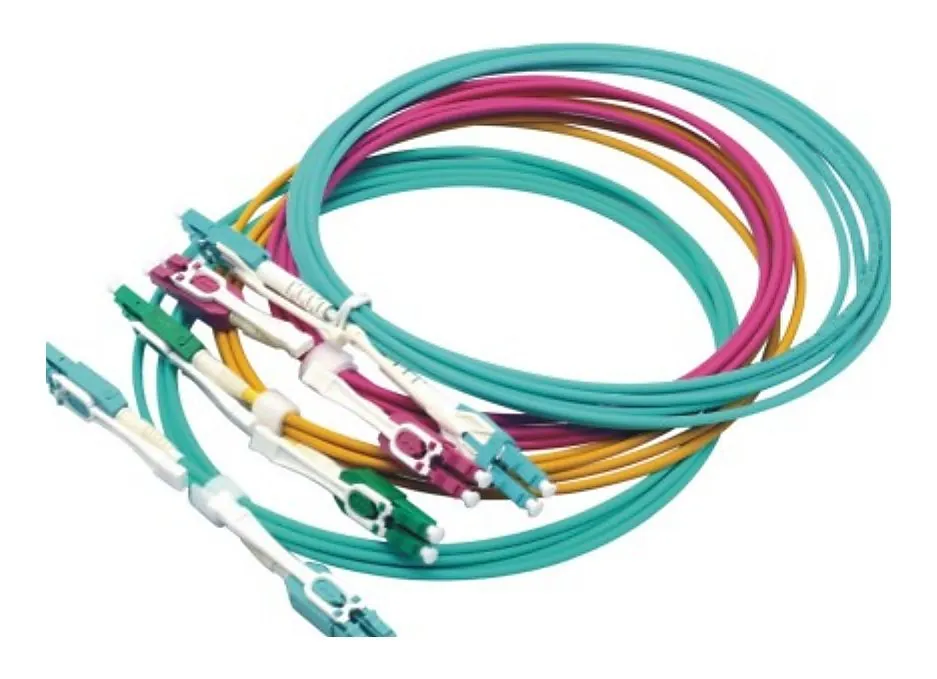
Coiled aqua, magenta and yellow fiber patch cords with LC uniboot connectors

What OM4 and OM5 Have in Common

OM4 and OM5 belong to the same family. Both have a 50 µm core and 125 µm cladding, both are designed for VCSEL transceivers, and both use the same connectors (LC, SC, MPO) and the same patch cord constructions. In ISO/IEC 11801 and IEC 60793-2-10 terms they are A1-OM4 and A1-OM5; in North America, ANSI/TIA-492AAAF now covers the multimode fiber specifications that earlier editions split across separate documents.

The headline numbers at 850 nm are identical. As Cisco's white paper on the two fibers puts it, OM5 offers no reach benefit over OM4 with transceivers that operate only at 850 nm, and the vast majority of multimode transceivers do.

OM4 and OM5 fiber specifications (ISO/IEC 11801 values, as cited by Cisco and TIA FOTC)
ParameterOM4OM5
Core / cladding50 / 125 µm50 / 125 µm
Effective modal bandwidth at 850 nm4700 MHz·km4700 MHz·km
Effective modal bandwidth at 953 nmNot specified2470 MHz·km
Overfilled launch bandwidth 850 / 1300 nm3500 / 500 MHz·km3500 / 500 MHz·km
Designed wavelength range850 nm850 to 953 nm (wideband)
Usual jacket color (TIA-598)Aqua; violet is used in some marketsLime green

Where OM5 Is Different

OM5 is often called wideband multimode fiber. The extra specification at 953 nm guarantees bandwidth across the 850 to 953 nm window, which is what short-wavelength division multiplexing (SWDM) and bidirectional optics use when they put two or four wavelengths on one fiber. OM4 is only specified at 850 nm; its bandwidth at longer wavelengths is not controlled and varies between fibers. Fluke Networks sums it up as OM5 being essentially OM4 with an added specification for operation at 953 nm.

That is also why OM5 is backward compatible: an OM5 cord or trunk works with every optic that runs on OM4, at the same reach.

Reach by Transceiver: Where OM5 Helps

Reach on OM4 and OM5 for common multimode Ethernet interfaces
InterfaceWavelengthsOM4 reachOM5 reachOM5 benefit
10GBASE-SR850 nm400 mSame as OM4None
40GBASE-SR4 (IEEE 802.3ba)850 nm150 mSame as OM4None
100GBASE-SR4 (IEEE 802.3bm)850 nm100 m100 mNone
400GBASE-SR4.2 (IEEE 802.3cm), bidirectional850 and 910 nm100 m150 mAbout 50% longer reach
SWDM4 multi-source agreement modulesFour wavelengths, 850 to 940 nmPer data sheetLonger than OM4, per data sheetYes

Sources: IEEE 802.3 application tables published by the TIA Fiber Optics Tech Consortium, Cisco and CommScope. Always confirm the reach with the data sheet of the exact module, because vendor-specific optics (for example extended-reach SR4 variants) set their own limits.

The practical reading: if the switch ports in the room are SR, SR4 or SR8 optics, OM5 buys nothing. If the plan includes 400G SR4.2 or SWDM optics over runs longer than about 100 m, OM5 is the fiber that makes those runs possible on multimode.

Which Patch Cord to Buy

OM4 vs OM5 patch cord decision guide
Your situationBuyReason
850 nm optics only (SR, SR4, SR8), new or existing OM4 plantOM4Same reach, usually lower price and wider stock
Existing OM5 backboneOM5Keep the channel one fiber grade so it can be documented as OM5
Plan for 400G SR4.2 or SWDM over more than 100 mOM5 cords and trunksOM5 is the only multimode grade specified at the longer wavelengths
Mixed rooms, OM4 and OM5 both installedMatch each channel; color-code jacketsLime green and aqua make the grade visible at the patch panel
Runs well beyond multimode reachOS2 singlemodeNeither OM4 nor OM5 is the right fiber

A short OM4 cord on an OM5 trunk will connect and pass light, because the core size and connectors are the same. The channel then cannot be described as OM5 end to end, and its performance at the longer wavelengths is no longer specified. Our advice is simple: keep the cord grade equal to the backbone grade, and never mix 50 µm fiber with 62.5 µm OM1 or with singlemode.

Patch Cord Details That Matter More Than the Grade

Once the grade is chosen, most problems with multimode patch cords come from the cord itself rather than from the fiber class. These are the fields we check on every multimode line before quoting:

  • Connector and polish. Multimode LC and SC are flat polished (PC/UPC). Multimode MPO is normally flat polished too; APC is used mainly on singlemode.
  • Polarity. Duplex cords are A-to-B unless the design calls for A-to-A; see our A-to-B vs A-to-A polarity guide. MPO cords need a polarity type; for parallel optics see the SR4 MPO polarity guide.
  • Boot style. Uniboot LC cords take less space at dense switch ports; see LC uniboot patch cords.
  • Jacket rating. LSZH, OFNR or OFNP according to the building code where the cords are installed.
  • Labels. Fiber grade printed on the jacket and a label at each end per the port map.
  • Test data. Insertion loss per connector and end-face inspection records.
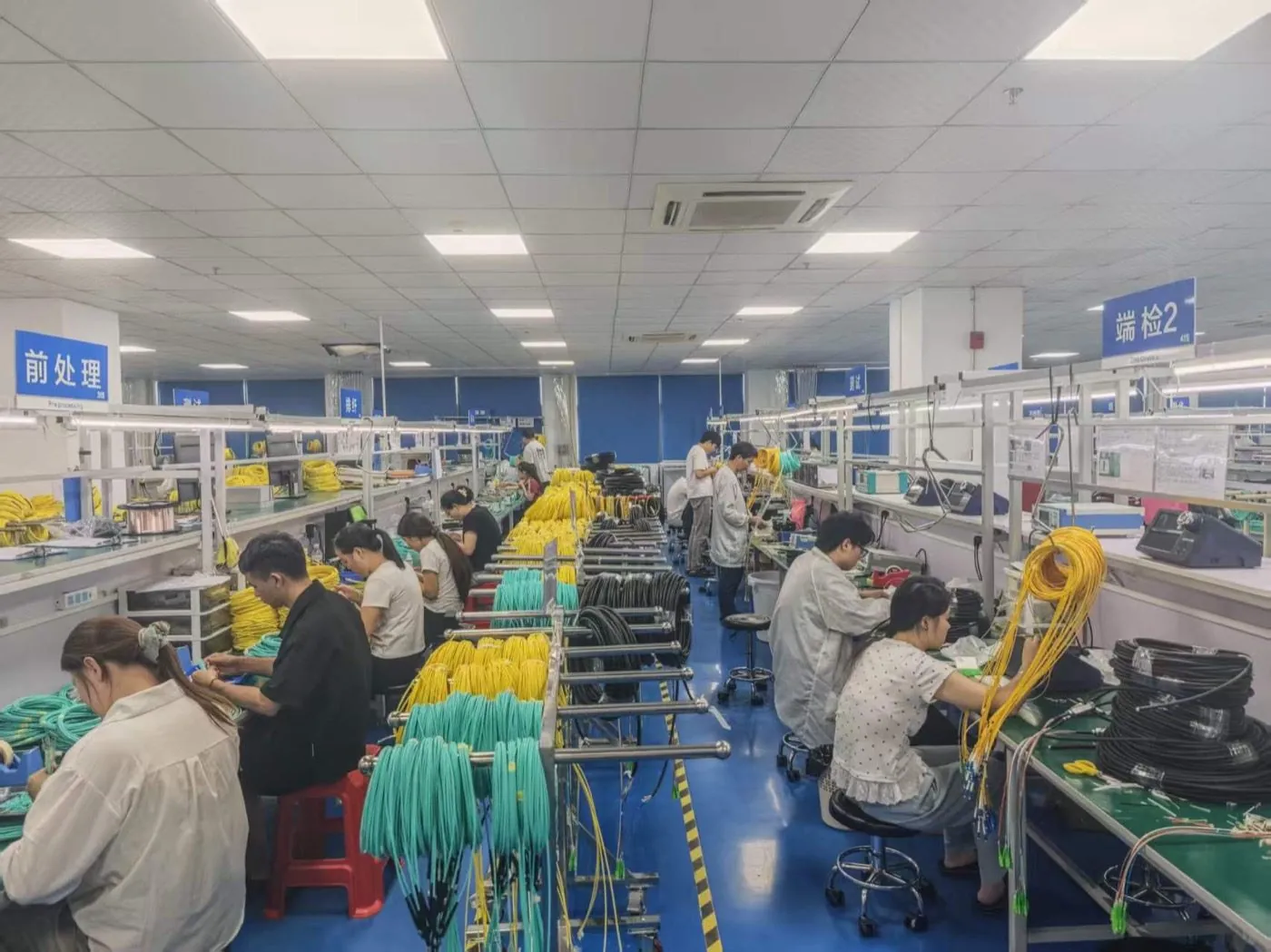
Patch cord assembly line in our own factory, with two rows of workstations where workers handle yellow and aqua fiber cords

Writing OM4 or OM5 on an RFQ

"Multimode cord" or "aqua cord" is not enough, because aqua is used for both OM3 and OM4. Write the grade by name on every line. The lines below show the format with example values; they are not a real order.

Example multimode patch cord RFQ lines
LineExample
PC-01LC/UPC to LC/UPC duplex, OM4, A-to-B, 2.0 mm round, LSZH aqua, 3 m
PC-02LC/UPC uniboot to LC/UPC uniboot, OM5, A-to-B, LSZH lime green, 2 m
MPO-01MPO-12 to MPO-12, Base-8, OM4, Type B, unpinned both ends, 5 m
TestsInsertion loss per connector, end-face inspection
Labels and packingGrade and length on label; one cord per bag; carton marks per destination
CommercialQuantity per line, destination country, required date

Fields that are not decided can be marked "to be confirmed per project". Our wholesale page lists the standard options; see fiber optic patch cord wholesale.

Common OM4 and OM5 Buying Mistakes

  • Paying for OM5 to get more 850 nm reach. There is none; the 850 nm specification is the same.
  • Ordering by color. Aqua can mean OM3 or OM4, and violet is a market convention, not a grade.
  • Mixing grades in one channel. The link may work today and fail to certify or to support a later optic.
  • Forgetting the optic. The module data sheet, not the cable, sets the reach and loss budget.

FAQ

OM4 vs OM5 Patch Cord FAQ

Is OM5 better than OM4 for 100G SR4?

No. 100GBASE-SR4 runs at 850 nm only, and OM4 and OM5 have the same 850 nm bandwidth, so both support 100 m.

Can I connect an OM4 patch cord to an OM5 cable?

Yes, they share the 50 µm core and the same connectors. The channel is then no longer OM5 end to end, so keep the grades matched where you plan multi-wavelength optics.

What color is an OM5 patch cord?

Lime green under TIA-598. OM4 is normally aqua, and some markets use violet for OM4.

When should I choose an OM5 patch cord?

When the backbone is OM5, or when you plan multi-wavelength optics such as 400GBASE-SR4.2 or SWDM modules over runs where OM4 reach is not enough.

Does OM5 work with existing multimode transceivers?

Yes. OM5 is backward compatible with optics designed for OM4 and gives the same reach with them.

Sources and Further Reading

Standards and public references describe definitions and industry practice; they are not Lumafyn product data. Optical values, MOQ and lead time for your order are confirmed in your quotation and test records.

Related products and guides

Get a Quote