
US import notes
Fiber Optic Patch Cord HS Code: Official HTS Conditions, Not One Automatic Number
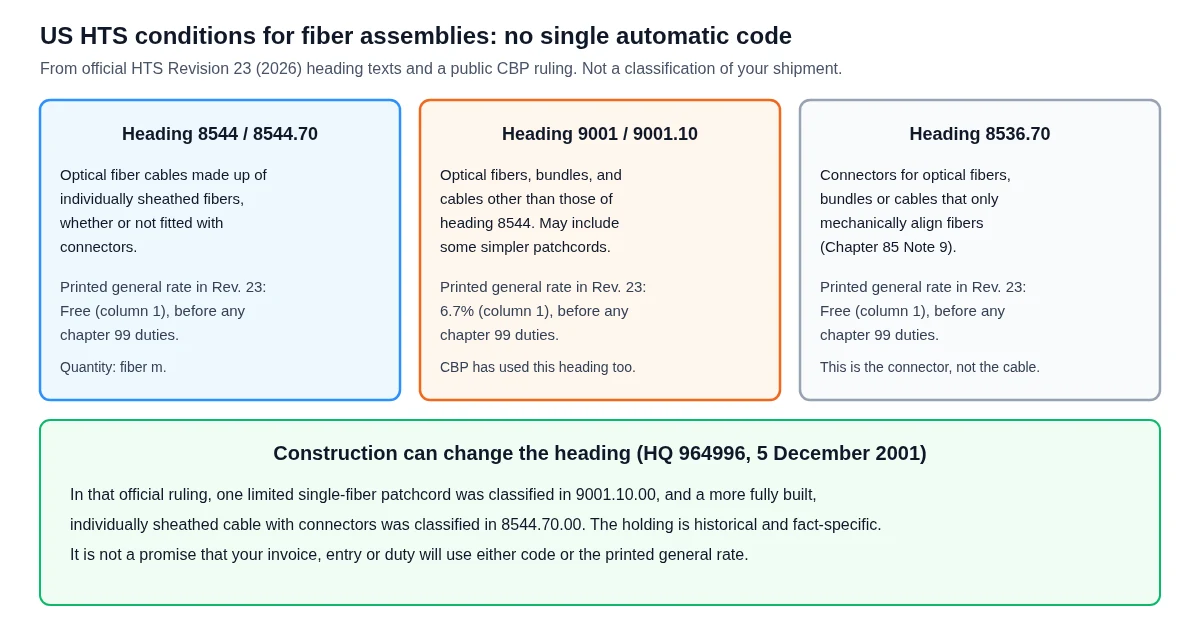
There is no single Harmonized Tariff Schedule number that automatically applies to every fiber optic patch cord imported into the United States. The official heading texts distinguish optical fiber cables made up of individually sheathed fibers (heading 8544, subheading 8544.70), optical fibers, bundles and cables other than those of heading 8544 (heading 9001, subheading 9001.10), and connectors that only mechanically align fibers (subheading 8536.70). Published CBP rulings have used more than one of those provisions, depending on the article in front of the officer. This guide quotes official public entries and their conditions. It is not a classification ruling, not legal advice, and not a promise of the code or duty on your entry.
Published 2026-11-19 · Last reviewed 2026-11-19 · By the Lumafyn Technical Team
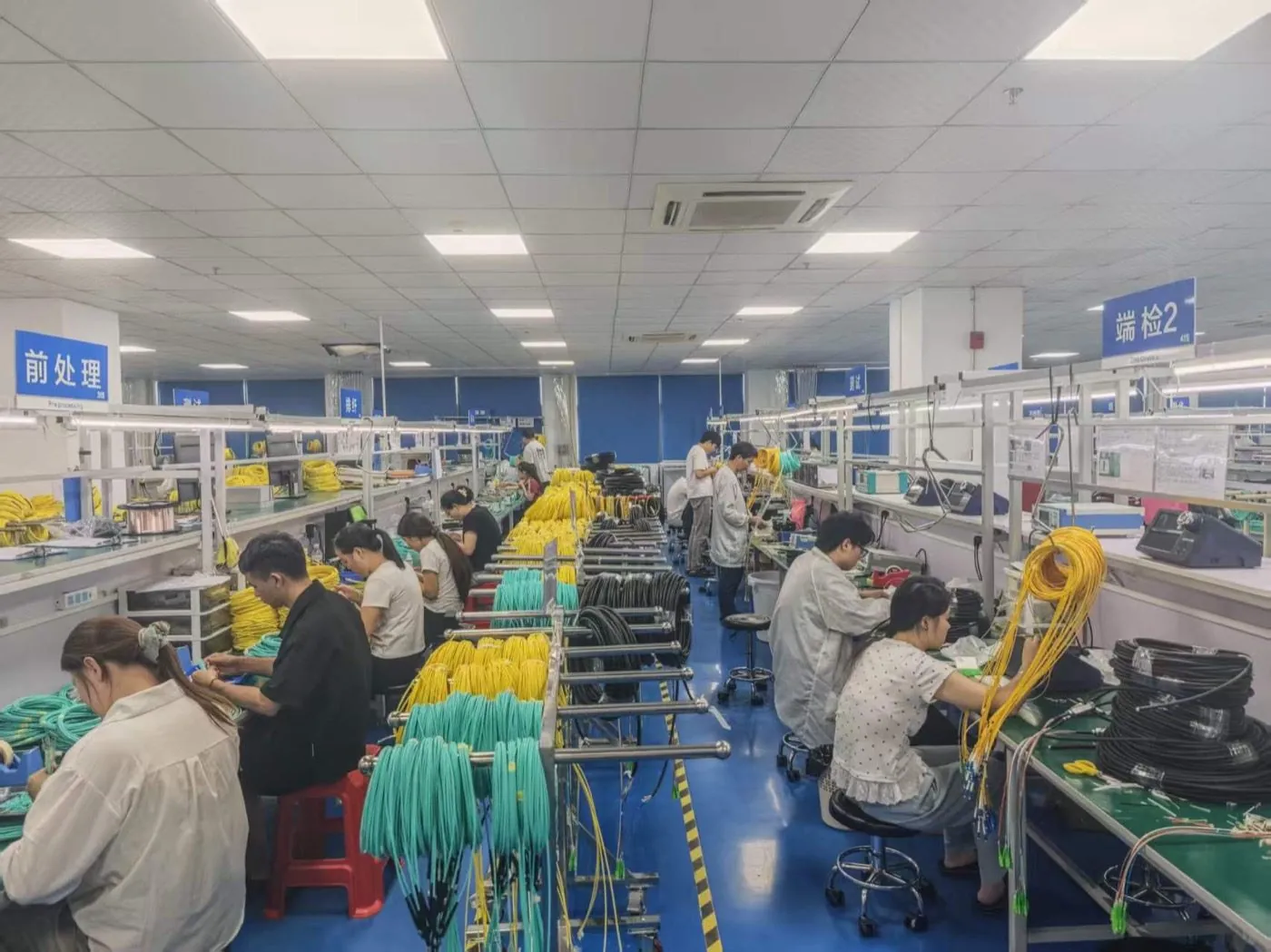
Lumafyn products are made at an ISO 9001 / ISO 14001 / ISO 45001 certified production base (management-system certificates issued by NOA). The certificates cover the production base, not individual products.
View certificates →Is there one HS code for a fiber optic patch cord?
No. “Fiber optic patch cord” is a commercial name. The HTS classifies the article as imported, using the legal heading text, the General Rules of Interpretation, and, where they exist, published rulings on similar goods. Two assemblies that both look like jumpers can still fall in different headings if one is a limited single fiber with connectors and the other is an individually sheathed cable with strength members and a jacket.
The official files opened for this guide are the Harmonized Tariff Schedule of the United States, Revision 23 (2026), Chapter 85 and Chapter 90, retrieved as PDF from hts.usitc.gov on 18 November 2026, and selected public rulings from the CBP CROSS official ruling interface on the same day. Chapter 99, which can add temporary or trade-action duties, was not opened for this article, so no additional-duty rate is quoted here.
The importer of record, usually with a licensed customs broker, has to classify the actual shipment against the current schedule. Lumafyn does not assign a United States tariff number on a customer’s entry and does not guarantee a rate.
What do the official HTS headings actually say?
Three legal texts matter most when the commercial name is “patch cord,” “jumper,” or “fiber assembly.”
| Provision | What the official text covers | Printed column 1 general rate in Rev. 23 | Printed column 2 rate in Rev. 23 |
|---|---|---|---|
| Heading 8544 / 8544.70.00 | Heading 8544 includes “optical fiber cables, made up of individually sheathed fibers, whether or not assembled with electric conductors or fitted with connectors.” Subheading 8544.70.00 is “Optical fiber cables,” unit fiber m. | Free | 65% |
| Heading 9001 / 9001.10.00 | Heading 9001 includes “optical fibers and optical fiber bundles; optical fiber cables other than those of heading 8544.” Subheading 9001.10.00 is “Optical fibers, optical fiber bundles and cables.” | 6.7% | 65% |
| 8536.70.00 | “Connectors for optical fibers, optical fiber bundles or cables,” unit No. Chapter 85 Note 9 limits this to connectors that simply mechanically align optical fibres end to end in a digital line system and perform no other function such as amplification, regeneration or modification of a signal. | Free | 45% |
Chapter 90 Note 1(h) excludes from Chapter 90 both “connectors for optical fibers, optical fiber bundles and cables (heading 8536)” and “optical fiber cables of heading 8544.” In other words, an article that meets heading 8544 is not classified in 9001, and a simple mechanical optical connector is directed to heading 8536 rather than to Chapter 90.
Statistical Note 4 to Chapter 85 says that, for subheading 8544.70, the unit “fiber m” is the number of individual fibers multiplied by the length in meters. Chapter 90 has a parallel statistical note for subheading 9001.10. Those notes are about how quantity is reported. They do not decide which heading applies.
What have official CBP rulings said about patchcords?
Published rulings are fact-specific and can be revoked or modified. They are still the right official source for seeing that construction, not the word “patch cord,” has driven the heading.
Headquarters ruling HQ 964996 (5 December 2001), retrieved from the official CBP CROSS ruling interface on 18 November 2026, classified two different patchcords in two headings. The holding states that, at GRI 1, “patchcord one” was classifiable in subheading 9001.10.00 as optical fibers, optical fiber bundles and cables, and that “patchcord two” was classifiable as an individually sheathed single-strand optical fiber cable with connectors in subheading 8544.70.00. The same ruling describes patchcord one as a limited single-fiber construction and patchcord two as a more fully built, individually sheathed cable. That contrast is the point of citing it: the commercial name was “patchcord” in both cases; the heading followed the article.
Headquarters ruling HQ 964883 (14 September 2001) classified a single strand of buffered or jacketed optical fiber with a connector at each end in subheading 9001.10.00. HQ 964996 itself refers to that earlier decision when discussing the more limited construction.
Later New York rulings on fiber cables with individually sheathed fibers have used 8544.70.0000. NY N065166 (22 June 2009) and NY N145141 (14 February 2011), also retrieved from the official interface on 18 November 2026, are examples. NY N145141 describes a duplex cable of two individually sheathed optical fibers and strength members in a common outer jacket and holds the applicable subheading to be 8544.70.0000. Those letters concern the merchandise then before CBP. They do not classify a later, different design, and they do not freeze today’s duty.
If your assembly is only loose connectors, heading 8536 and Note 9 are the official starting point, not 8544.70. If it is a cable of individually sheathed fibers, with or without connectors, the heading 8544 text is the starting point. If it is optical fiber or a cable that does not meet heading 8544, heading 9001 is the residual official text. The broker still has to apply the rules to the goods on the invoice.
What rates are printed, and what this guide will not promise
The column 1 general rates printed in Revision 23 (2026) of the official chapters opened here are: 8544.70.00 Free; 9001.10.00 6.7%; 8536.70.00 Free. Column 2 rates in the same files are 65%, 65% and 45% respectively. Special-program rates also appear in the 9001.10.00 and other lines; this guide does not map those program letters to a claim of preference for any origin.
Those printed general rates are not the duty you will necessarily pay. Additional duties, including measures set out in Chapter 99, may apply depending on origin, date of entry and the current notes. Because the official Chapter 99 file was not opened for this article, no Section 301, reciprocal, or other additional rate is stated here. Third-party tariff websites already disagree with one another on those add-ons; they are not a substitute for the official schedule.
Rulings also remind the reader that duty rates can change and that the current HTS controls. HQ and NY letters that printed “free” in 2001, 2009 or 2011 do not lock the rate for an entry made under Revision 23, or under a later revision.
What should a US buyer still put on an RFQ or an entry file?
Give the broker a description that matches the goods, not only the catalogue title “patch cord.”
| Item | Why it matters against the official texts |
|---|---|
| Construction | Whether each fiber is individually sheathed; whether there is a buffer, strength members and an outer jacket; fiber count and length |
| Connectors | Fitted on a cable, or packed as loose connectors that only align fibers (Note 9 to Chapter 85) |
| What the article is not | Active transceivers, apparatus that regenerates or switches a signal, or other heading 8517 equipment — those are outside this guide |
| Evidence | A drawing or cutaway, a packing list that matches the invoice, and the current official HTS, including Chapter 99 if it may apply |
| Who decides | The importer of record and, typically, a licensed customs broker; a binding ruling from CBP if the risk justifies it |
Standard jumper ranges are listed on the fiber optic patch cord wholesale page. Non-standard lengths and labels go through the custom fiber patch cord page. US delivery context sits on the United States fiber optic supplier page. None of those pages assigns an HTS number to your entry.
This article does not add product certifications, a minimum order, a lead time, or any delivery-term or origin-preference statement. Optical values for an order are confirmed on the quotation and the test records. Classification and duty remain the importer’s responsibility under the current official schedule.
What mistakes should you avoid when talking about a patch-cord HS code?
- Putting one number, such as 8544.70, on every invoice as if the commercial name decided the heading. Official rulings have used 9001.10.00 for some patchcords and 8544.70 for others.
- Copying a duty percentage from a trade blog or a lookup tool, especially when those tools disagree, instead of reading the current official HTS, including Chapter 99.
- Treating a 2001 or 2009 ruling as a live rate sheet, or as a classification of a different construction.
- Classifying loose connectors as if they were cables, or the reverse, without reading heading 8536, Note 9, and the 8544 / 9001 texts.
- Asking a supplier to “guarantee” the code or the duty on the customer’s US entry. That is not what this guide, or a product quotation, can do.
FAQ
Fiber Optic Patch Cord HS Code FAQ
What is the HS code for a fiber optic patch cord in the United States?
There is no single automatic code. Official HTS texts and published CBP rulings point to 8544.70, 9001.10 or, for loose mechanical connectors, 8536.70, depending on the article. The importer and broker must classify the actual goods against the current schedule.
Why do some sources say 8544.70 and others say 9001.10?
Because the legal headings describe different articles. Heading 8544 covers optical fiber cables made up of individually sheathed fibers, whether or not fitted with connectors. Heading 9001 covers optical fibers, bundles and cables other than those of heading 8544. HQ 964996 classified two patchcords, one in each subheading.
Can Lumafyn tell me the duty rate for my shipment?
No. This guide only quotes general rates printed in HTS Revision 23 (2026) for the three provisions named above, and it does not quote Chapter 99 additional duties, which were not opened here. Current duty depends on classification, origin and the schedule in force on the date of entry.
Do connectors use the same heading as a finished patch cord?
Not necessarily. Subheading 8536.70 is for connectors that only mechanically align optical fibers, as defined in Chapter 85 Note 9. A complete cable assembly is assessed under the cable headings if it meets those texts.
Are older CBP rulings still binding on my entry?
A ruling is official and fact-specific. It may be modified or revoked, and it does not automatically classify a different design or lock a rate. Use current official texts and, if needed, a new ruling request. This page is not a ruling.
Does this article apply a code to Lumafyn products?
No. It explains official public texts. Classification of a shipment is made by the importer of record on the entry, not by this guide.
Sources and Further Reading
- USITC Harmonized Tariff Schedule search (official site; Chapter 85 and Chapter 90, Revision 23 (2026), PDFs retrieved 18 November 2026)
- Official HTS Revision 23 (2026) Chapter 85 PDF (headings 8536.70 and 8544.70, Note 9, Statistical Note 4)
- Official HTS Revision 23 (2026) Chapter 90 PDF (heading 9001, Note 1(h), 9001.10.00)
- CBP HQ 964996, 5 December 2001 (official CROSS record: two patchcords, 9001.10.00 and 8544.70.00)
- CBP HQ 964883, 14 September 2001 (official CROSS record: 9001.10.00)
- CBP NY N065166, 22 June 2009 (official CROSS record: 8544.70.0000)
- CBP NY N145141, 14 February 2011 (official CROSS record: 8544.70.0000)
Standards and public references describe definitions and industry practice; they are not Lumafyn product data. Optical values, MOQ and lead time for your order are confirmed in your quotation and test records.