
Buyer Guide · United States
Fiber Pigtail vs Patch Cord: Differences and Typical Uses
A fiber pigtail is a short length of fiber with a connector (or another component) on one end and bare or unterminated fiber on the other, typically spliced onto an installed cable. A patch cord — also called a jumper cable — is a short cable with connectors on both ends, used to interconnect patch panels, cassettes and equipment. Those are the Fiber Optic Association (FOA) definitions this page follows. The two products are not interchangeable: a pigtail is made to be spliced; a patch cord is made to be mated and unmated. Optical values, MOQ and lead time for either product are confirmed in your quotation and test records.
Published 2026-11-17 · Last reviewed 2026-11-17 · By the Lumafyn Technical Team
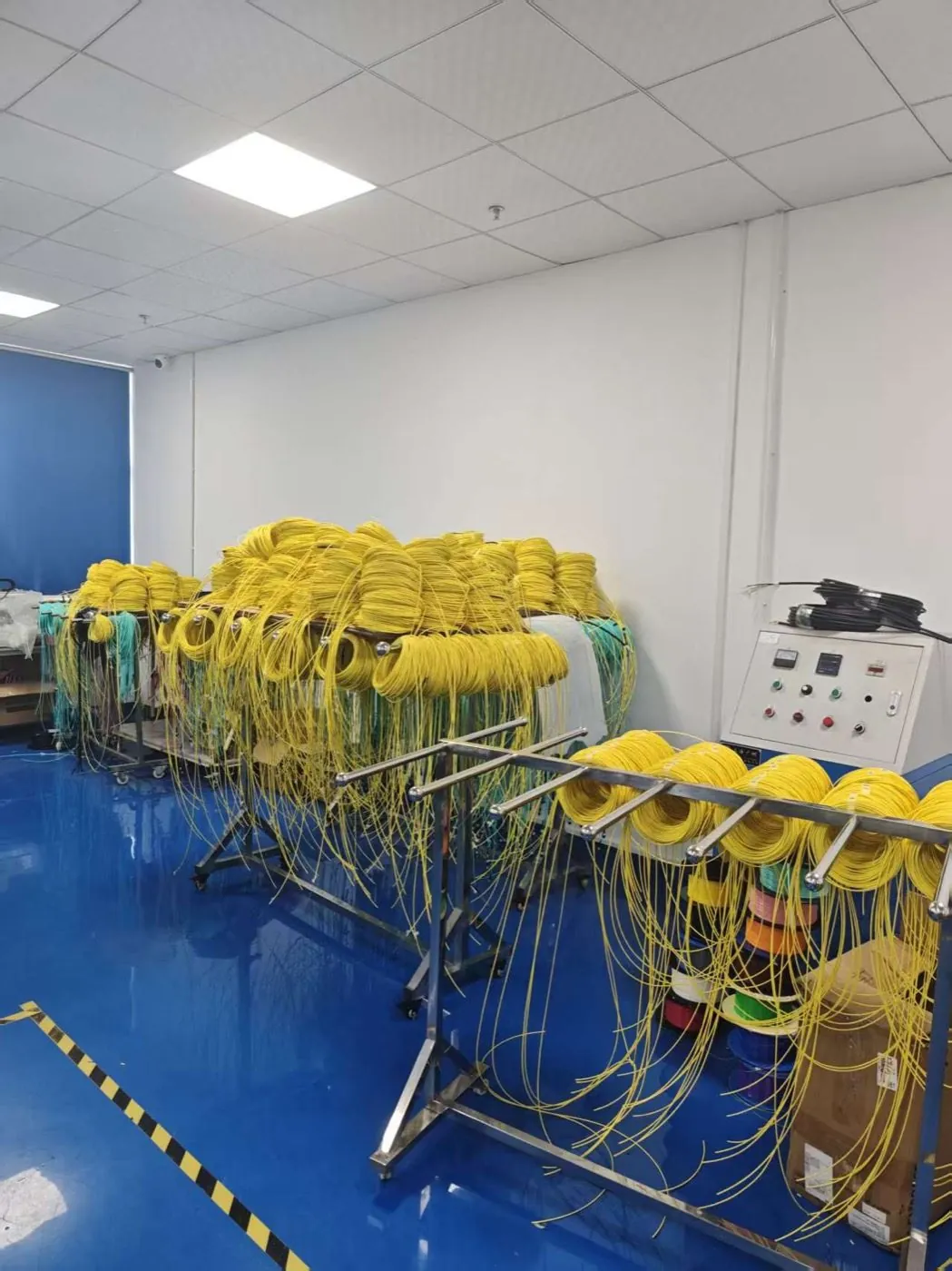
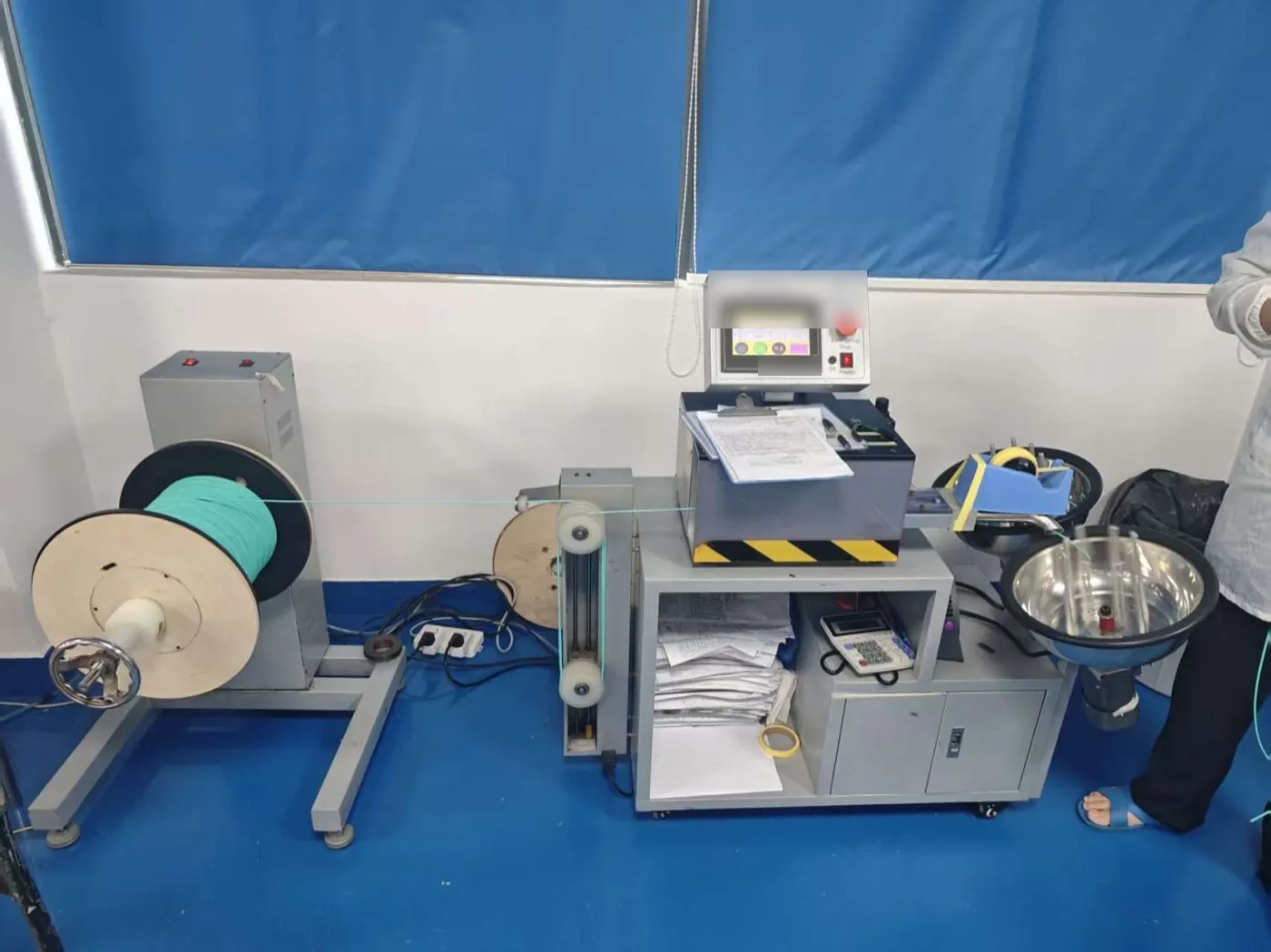
Lumafyn products are made at an ISO 9001 / ISO 14001 / ISO 45001 certified production base (management-system certificates issued by NOA). The certificates cover the production base, not individual products.
View certificates →The Difference in One Sentence
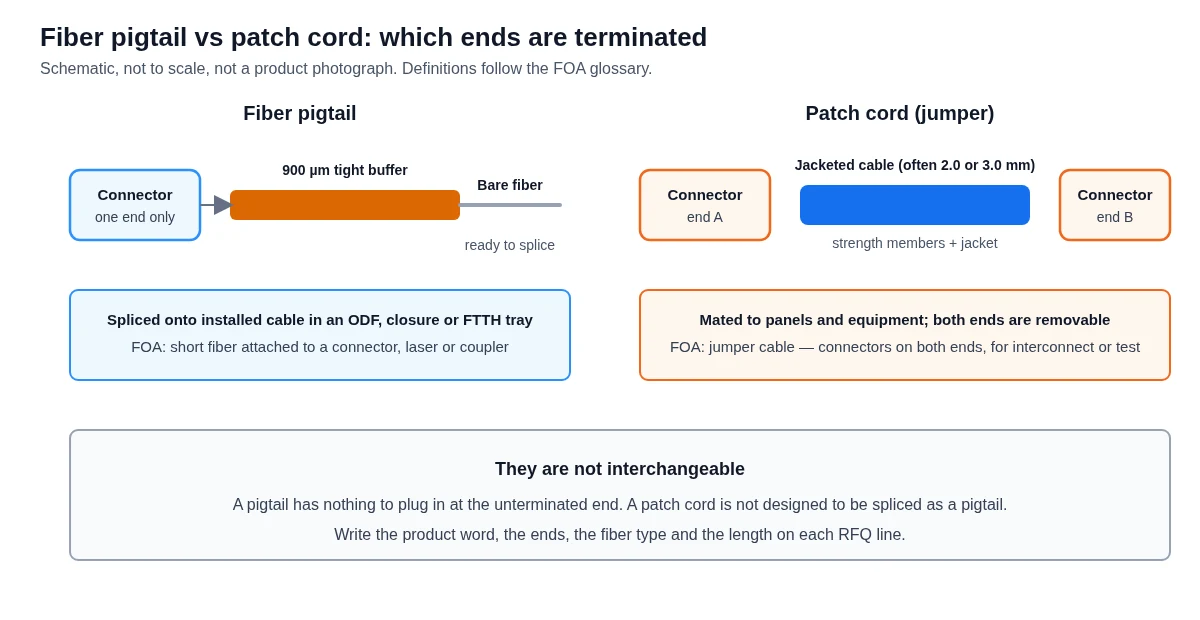
The difference between a fiber pigtail and a patch cord is which ends are terminated: a pigtail carries a connector on one end so the other end can be spliced; a patch cord carries connectors on both ends so it can be patched. FOA’s glossary defines a pigtail as “a short length of fiber attached to a fiber optic component such as a connector, laser or coupler,” and a jumper cable as “a short single fiber cable with connectors on both ends used for interconnecting other cables or testing.”
This page stays on that distinction and on how to write each product on an RFQ. It does not replace the 12 color SC APC pigtail product page, and it does not redo the fiber color-code guide. For jacket and connector colours in a European wording, see fibre patch lead colours; the single-fiber color order used in trays is covered on the existing TIA-598 page.
| Point | Fiber pigtail | Patch cord (jumper) |
|---|---|---|
| FOA meaning | A short length of fiber attached to a component such as a connector, laser or coupler. A connector pigtail is spliced onto a cable as an alternative to direct termination. | A short cable with connectors on both ends, used to interconnect other cables or to test them. FOA’s glossary entry uses the name jumper cable for this assembly. |
| Ends | One connector (or other component); the other end is bare fiber, usually with a 900 µm tight buffer, ready to strip and splice. | A connector on both ends, on a jacketed simplex or duplex cord (often 2.0 mm or 3.0 mm). |
| Typical job | Terminate loose-tube or distribution cable in an ODF, splice tray, closure or FTTH terminal by fusion splicing. | Cross-connect a panel to equipment, or equipment to equipment, and serve as a removable test lead. |
| How it is joined to the plant | Fusion splice (sometimes a mechanical splice) onto the installed fiber, then the splice is protected in a tray or sleeve. | Mated through an adapter or a transceiver port; no splice in the jumper itself. |
| Re-use | The spliced end is not meant to be unplugged from the cable; the connector end can be unplugged from an adapter. | Both ends are made to be mated and unmated many times, with cleaning and inspection between mates. |
| Usual construction | 900 µm tight-buffered fiber, often supplied as singles or as a 12-color set for tray work. | Jacketed zip-cord or simplex cable with aramid strength members, as FOA describes for indoor patch-cord applications. |
How Each One Is Built
Most connector pigtails used in cabinets are a factory-polished connector on a short 900 µm tight-buffered fiber. The 900 µm buffer is there so a splicer can strip, clean and cleave the fiber and join it to a 250 µm or 900 µm fiber coming out of a loose tube, a distribution cable or a drop. The buffer is not a substitute for a jacketed cord: it has no aramid strength members and is not intended to be pulled as a patch cord.
A patch cord starts from the same kind of 900 µm tight-buffered fiber and adds strength members and a jacket. FOA’s cable page describes simplex indoor cable as tight-buffered fiber (900 µm over the primary coating) with aramid strength members and a jacket that is usually 3 mm in diameter, and zip-cord as two of those jackets joined by a thin web. Those constructions are what most LC and SC jumpers use, in 2.0 mm or 3.0 mm jackets depending on the density of the panel.
Ribbon pigtails are a related construction: FOA notes that ribbon pigtails are spliced onto ribbon cable for a faster mass termination. They still follow the same rule — one side is prepared for splicing, the other side presents connectors — and should be specified as ribbon pigtails, not as ordinary 900 µm singles.
Where a Fiber Pigtail Is the Right Choice
A pigtail is the right choice when the installed cable cannot, or should not, be connectorized fiber by fiber on site, and a factory-polished connector is needed at the panel. FOA’s cable guidance is that loose-tube cables with single-mode fibers are generally terminated by splicing pigtails onto the fibers and protecting them in a splice closure. That is the everyday pattern in an ODF, a building distribution frame, a splice closure and many FTTH terminals.
- Loose-tube outside-plant cable entering a frame: the 250 µm fibers are spliced to 900 µm pigtails, and the pigtail connectors land on adapters in the panel.
- FTTH or GPON terminals where a splitter output or a drop is spliced to an SC/APC pigtail so the port can be patched later. For box names used on those terminals, see FAT, ODP, ODC and OTB.
- Twelve-fiber trays that use a color-coded pigtail set so each spliced fiber stays identifiable. Order those as a set when you need the full color sequence; the product page describes 12-color SC/APC sets.
- Repairs or additions in a live tray, where a single pigtail can be spliced in without re-terminating a whole jacketed jumper.
Because one end is bare, a pigtail is not a substitute for a patch cord on a transceiver port or a patch-panel front. There is nothing to plug in at the unterminated end.
Where a Patch Cord or Jumper Is the Right Choice
A patch cord is the right choice when both ends must be removable. FOA’s patchcord page states that patchcords are used to cross-connect installed cables and to connect communications equipment to the cable plant, and that the fiber type, jacket color and connectors must match the plant and the equipment.
- Panel to equipment, or cassette to switch, including LC duplex jumpers on SFP and QSFP breakout ports.
- Panel to panel cross-connects in a meet-me room or a building distributor.
- Test leads and reference jumpers, which FOA’s glossary also includes under jumper cable.
- Hybrid jumpers when the panel connector and the equipment connector differ, for example LC to SC. Identify the ports first with the connector types guide.
Match the fiber to the plant: 50/125 jumpers with 50/125 plant, 62.5/125 only with 62.5/125 plant, and the correct single-mode type where mode-field diameter matters. FOA also reminds buyers not to mix PC and APC connectors. Jacket color helps prevent mix-ups but does not replace the fiber type written on the RFQ. For a U.S. jacket discussion (including OFNR and OFNP as explanations, not listings), see the jacket materials guide.
Why You Should Not Substitute One for the Other
Ordering pigtails when the site needs jumpers, or jumpers when the site needs pigtails, is a receiving problem and an installation problem. A jacketed patch cord can be stripped back and spliced in an emergency, but that wastes the second connector, changes the length and is not how the cord was tested. A 900 µm pigtail can be pushed into an adapter only at the connector end; the bare end has no strain relief for a patching job.
Loss expectations also differ by process, not by the product name. FOA’s loss-budget page gives typical and maximum figures for connectors and splices as industry references (for example, 0.3 dB as a typical adhesive/polish connector value and 0.75 dB as the TIA-568 maximum acceptable connector loss, and less than 0.05 dB as a typical single-mode fusion splice). Those are published FOA figures, not Lumafyn specifications. A pigtail termination includes the factory connector and the field splice; a patch-cord link includes two mated connectors and no splice in the jumper itself. Count the actual joints in the channel rather than assuming one product is “lower loss” by name. For the end-to-end calculation that uses those connector and splice figures, see fiber optic loss budget.
What to Put on Each RFQ Line
Write pigtails and patch cords on separate lines. The fields overlap, but the ends are not the same.
| Field | Pigtail line | Patch-cord (jumper) line |
|---|---|---|
| Product word | Pigtail (or “connector pigtail”; say “ribbon pigtail” if that is what you need) | Patch cord or jumper |
| Fiber | Single-mode or multimode grade, and G.652.D or G.657.A1/A2 if you require a specific recommendation | Same, matched to the plant |
| Connector | Interface and polish on the terminated end only (for example SC/APC) | Interface and polish on end A and end B |
| Unterminated end | 900 µm tight buffer, or another buffer you specify; stripped length if you have a standard | Not applicable — both ends are connectors |
| Length | Length of the pigtail, and the set lengths if you are ordering a kit | Length between connector reference faces, with the tolerance to be confirmed in the quotation |
| Color or set | Single color, or a 12-color set and the color order you use | Jacket color; duplex polarity (A-to-B or A-to-A) |
| Test records | IL and RL on the connector, serialised if you need it, plus any end-face inspection method | IL and RL on both ends, serialised if you need it, plus any end-face inspection method |
The line examples you may have used on a previous order are still the right format, as long as the product word is correct. Limits, MOQ and lead time stay on the quotation. If you are buying both products for the same frame, send them on one bill of materials so the connector polish and the fiber grade stay consistent.
U.S. distributors and contractors who buy both jumpers and pigtails from one factory conversation can start on the United States fiber optic supplier page and attach the line list. Custom lengths, hybrid ends and special jackets for jumpers go through the custom fiber patch cords page.
FAQ
Fiber Pigtail vs Patch Cord FAQ
What is the difference between a fiber pigtail and a patch cord?
A pigtail has a connector on one end and unterminated fiber on the other, and is spliced onto installed cable. A patch cord, or jumper, has connectors on both ends and is used to interconnect panels and equipment. That follows the FOA glossary definitions used on this page.
Can I use a pigtail as a patch cord?
No. The unterminated end of a pigtail is meant to be spliced and protected in a tray, not plugged into a port. If you need two removable ends, order a patch cord.
Why are pigtails often 900 µm tight-buffered fiber?
The 900 µm tight buffer is the construction FOA describes as the next layer over the 250 µm primary coating on indoor tight-buffered fibers. It is sized for handling, stripping and splicing in a tray. A patch cord adds strength members and a jacket on top of that buffer.
When should I order a 12-color pigtail set instead of singles?
Order a 12-color set when a tray or closure will splice a 12-fiber group and you want each fiber’s color to stay identifiable. Singles are enough for repairs, one-fiber drops, or when you already have a color standard in stock. Color order itself is specified on the pigtail product page and the existing color-code guide, not as a new standard on this page.
What do you need to quote pigtails or patch cords?
For each line: the product word (pigtail or patch cord), fiber type, connectors and polish on each terminated end, length, color or set, quantity and destination, plus the test records you want. Optical values, MOQ and lead time are confirmed in the quotation and test records.
Sources and Further Reading
- FOA glossary: pigtail and jumper cable definitions
- FOA: Patchcords for fiber optic cable systems
- FOA: Fiber optic cables (900 µm tight buffer, simplex/zip-cord, loose-tube pigtail termination, ribbon pigtails)
- FOA: loss budget (typical and TIA-568 maximum connector loss; typical splice loss; not Lumafyn specifications)
- ITU-T G.657 (bend-insensitive single-mode fiber)
- ITU-T G.652 (standard single-mode fiber)
Standards and public references describe definitions and industry practice; they are not Lumafyn product data. Optical values, MOQ and lead time for your order are confirmed in your quotation and test records.