
EU fibre guide
How to Clean LC and SC Fibre Connectors: Inspect, Then Clean, Then Inspect
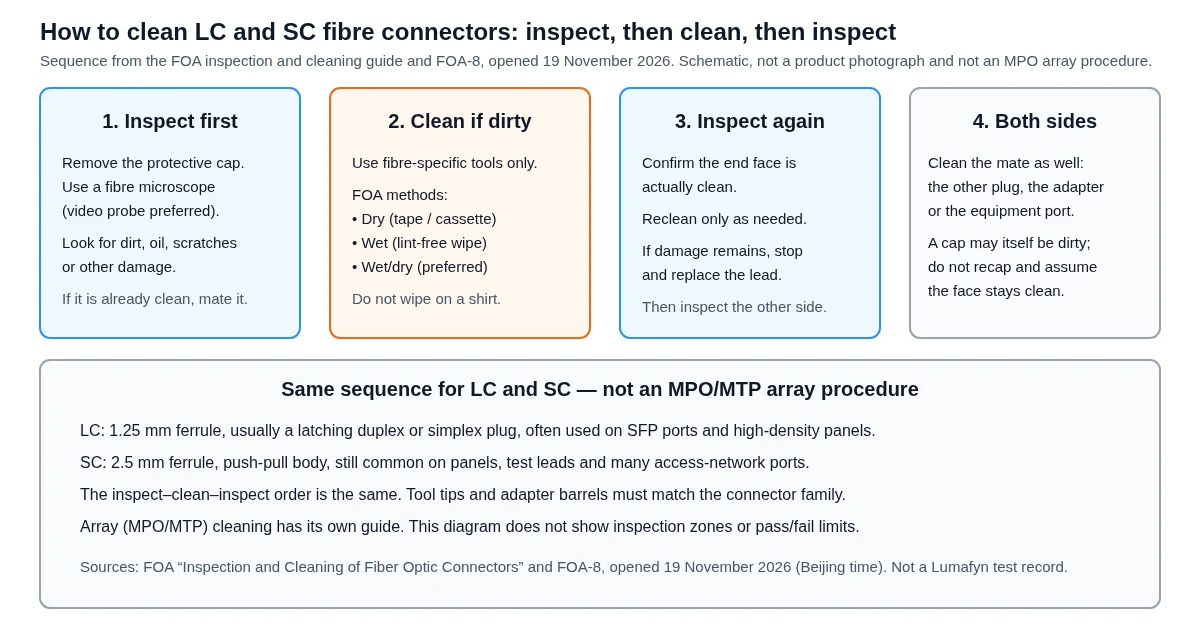
To clean LC and SC fibre connectors properly, inspect the end face first, clean it only if it is dirty, and inspect it again before you mate the connection. The Fiber Optic Association (FOA) sets out that sequence, and three cleaning methods — wet, dry, and wet/dry — in its public inspection-and-cleaning guide and in FOA-8, both opened on 19 November 2026. The same order applies to LC and to SC. It is not the same procedure as cleaning an MPO/MTP array connector. This guide does not invent inspection zone limits or a Lumafyn cleaning specification.
Published 2026-11-20 · Last reviewed 2026-11-20 · By the Lumafyn Technical Team
Lumafyn products are made at an ISO 9001 / ISO 14001 / ISO 45001 certified production base (management-system certificates issued by NOA). The certificates cover the production base, not individual products.
View certificates →Should you clean an LC or SC connector before you have inspected it?
You should inspect an LC or SC end face before you clean it, and inspect it again after cleaning, rather than wiping first and hoping. FOA-8, “Inspection and Cleaning of Fiber Optic Connectors,” opened on 19 November 2026 at thefoa.org/tech/ref/1pstandards/FOA-8.pdf, tells the technician to remove the protective cap, inspect the end face, decide whether cleaning is needed, and only then clean. After cleaning, the same document requires another inspection, and further cleaning if the face is still not acceptable.
The longer FOA reference page, “Inspection and Cleaning of Fiber Optic Connectors,” opened the same day at thefoa.org/tech/ref/testing/test/scope.html, makes the same point in the field: the type of dirt or residue is known only after you have looked. A shirt, a jacket or an unmarked wipe is not a cleaning method the FOA recommends.
How do you inspect an LC or SC end face safely?
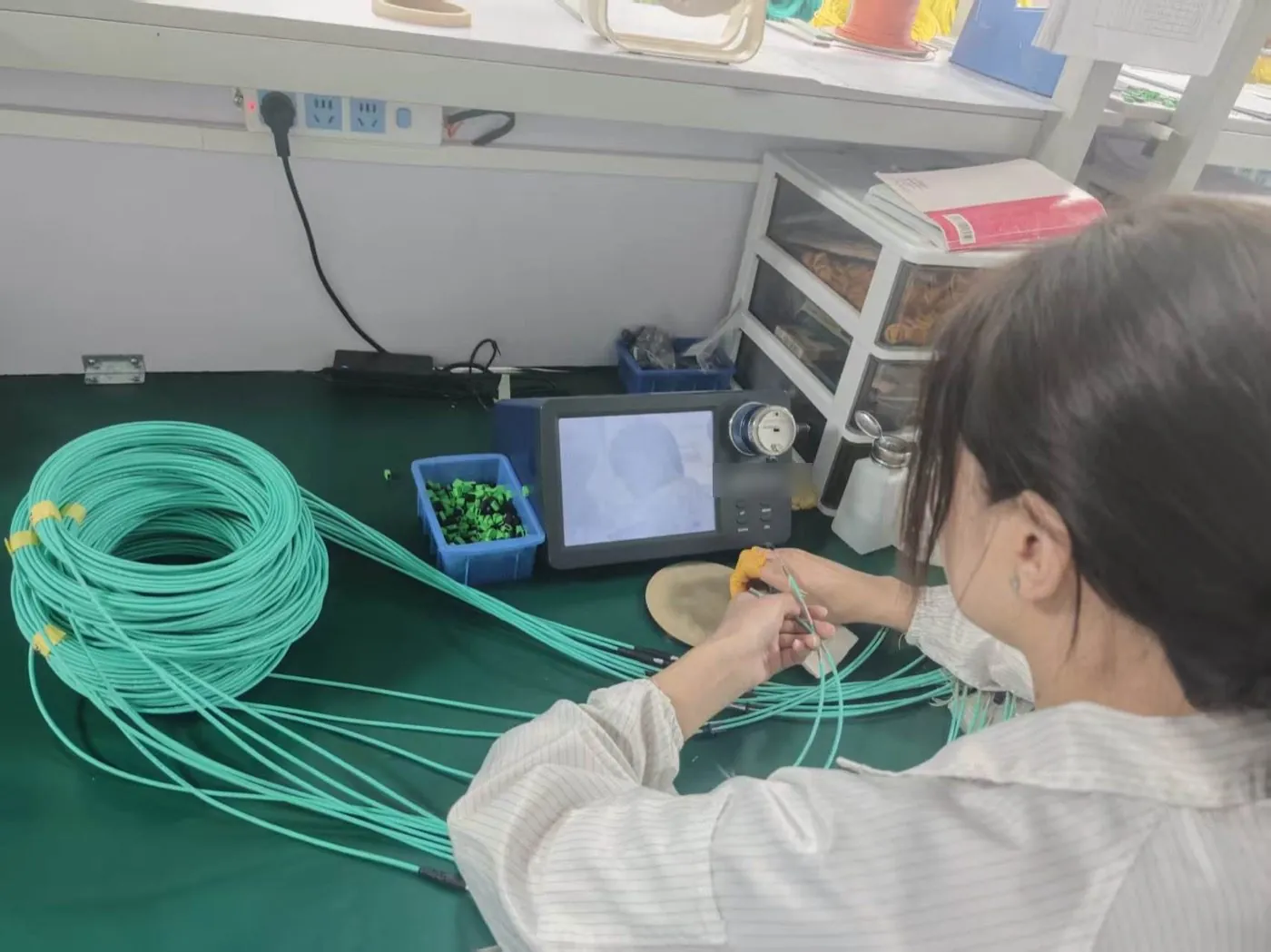
Inspect LC and SC connectors with a microscope made for fibre end faces, using a video probe where possible so you are not looking into a live fibre. FOA-8 calls for a microscope designed for fibre connectors, with the correct adapter, magnification in the 100–400× range, and proper illumination of the ferrule end. Optical (eye-piece) microscopes should have an infrared filter for eye protection. Video microscopes can record the image, and some can compare the face with a cleanliness standard.
The FOA reference page adds that, in the field, lower magnification is often more useful for cleanliness because it shows more of the ferrule, not only the core. Higher magnification is more helpful when you are judging a polish during termination. Factory-terminated leads may already have been inspected on a video microscope; that factory check is not a substitute for inspecting the same connector again immediately before it is mated in the field, after a cap has been removed, or after the lead has been in a kit bag.
LC uses a 1.25 mm ferrule; SC uses a 2.5 mm ferrule. The inspection sequence is the same, but the microscope adapter and any cleaning tip must match the connector family. A smear of oil, a chip, a scratch across the core, or leftover epoxy is not “dust that will wipe off in use.” If the face is already clean, mate it. If it is damaged rather than dirty, further cleaning will not repair it.
What cleaning methods does the FOA describe?
The FOA describes three cleaning methods — wet, dry, and wet/dry — and requires an inspection after cleaning. In FOA-8 those methods are: a damp lint-free wipe with a cleaning solution intended for the purpose (wet); special dry tape cleaners (dry); and a damp lint-free wipe followed by a dry lint-free wipe (wet/dry). The same list says to use products made for fibre-optic connectors, because other products may not clean the face or may harm it, and to reclean and inspect until the connector is acceptable.
The FOA reference page discusses the same three approaches in more detail. It notes that reagent-grade 99% isopropyl alcohol on a lint-free wipe was the older recommended solvent, but that bottled alcohol absorbs water from the air and can leave a residue. Sealed wet-to-dry pads, or a wipe that is wetted at one end so the face can be drawn from the wet area into the dry area in one motion, are described as a practical wet/dry method. The same page says wet/dry cleaning is generally preferred, because the wet step loosens contamination and the dry step removes it, and that some dry cleaners can leave a static charge that attracts more dirt.
Probe-style or cassette cleaners can reach a connector inside an adapter. Whatever tool you use, the FOA process still ends with an inspection. This article does not name a brand of cleaner, does not quote a cycle limit as a Lumafyn rule, and does not treat a “click” of a pen cleaner as a pass result.
| Method | What the FOA pages describe | What you still have to do |
|---|---|---|
| Inspect first | Remove the cap, inspect, and decide whether cleaning is needed | Do not skip this step because the lead looks new or still has a cap on |
| Dry | Special dry tape or cassette cleaners | Inspect afterwards; some dry tools can leave a static charge |
| Wet | A damp lint-free wipe with a cleaner intended for fibre connectors | Inspect afterwards; do not use a household wipe or a shirt |
| Wet/dry | Damp wipe then dry wipe, or a wet-to-dry stroke across one wipe | The FOA reference page generally prefers this method; inspect afterwards |
| Both sides | Clean both connectors when mating; clean receptacles or adapters as required | A clean plug can be dirtied at once by an uncleaned adapter or port |
How is this different from cleaning an MPO/MTP array?
An LC or SC connector is a single-fibre or duplex ceramic ferrule; it is not cleaned with the same array tools or zone checks as an MPO/MTP connector. The already published MPO/MTP end-face inspection and cleaning guide covers pinned and unpinned array connectors. This page does not take over that keyword, and it does not reprint an inspection-zone table from IEC 61300-3-35, because the official full text of that standard was not opened for this article.
What you can carry across from one guide to the other is the discipline: inspect, clean only if needed, inspect again, and treat both sides of the connection. What you should not carry across is the tool itself. An MPO cassette or a wide-ferrule probe is the wrong shape for an LC or SC plug, and a 1.25 mm LC tip does not clean a 2.5 mm SC adapter or an MPO array.
What mistakes should you avoid when cleaning LC or SC connectors?
Do not assume a protective cap has kept the end face clean, and do not mate a cleaned connector to an uncleaned adapter. FOA-8 is explicit that protective caps may contain dirt, that you should inspect and clean before connection, and that you should not replace the cap and expect the connector to remain clean. The FOA reference page makes the same joke industry-wide: they are often called “dust caps” because they may be filled with dust, and are better thought of as protective caps.
- Cleaning a connector on a shirt or a jacket. The FOA reference page uses that example as the method not to follow.
- Wiping first and inspecting later, or not inspecting at all. FOA-8 requires inspection before and after cleaning.
- Cleaning only one side of the connection. A dirty adapter or equipment port will contaminate a clean plug as soon as you mate it.
- Using a household solvent, a cotton swab, or a tool made for a different connector family. FOA-8 requires products intended for fibre-optic connectors.
- Treating scratches, chips or leftover epoxy as dirt that more solvent will fix. If the face is damaged, stop and replace or re-terminate the lead.
- Looking into a live fibre with an unfiltered optical microscope. FOA-8 calls for an IR filter on optical microscopes; a video probe keeps your eye off the beam.
What belongs on an RFQ or a handover note?
On an RFQ or handover note, name the connector type and polish, and keep field cleanliness checks separate from the factory test record of a finished lead. A useful request usually includes LC or SC (or both), simplex or duplex, UPC or APC if that polish matters on the plant, and whether the leads will be used as equipment cords, panel jumpers or test leads. If you need a record of insertion loss or a statement that the finished assemblies were inspected in production, ask for that on the quotation and the test records rather than treating this teaching sequence as a certificate.
Standard ranges are listed on the fiber patch cord wholesale page and on the custom fibre patch cord page. European delivery context sits on the Europe fibre optic supplier page. How to write a custom line, as opposed to how to clean a connector, is covered in how to specify custom fibre patch leads. None of those pages is a cleaning work instruction.
This article does not add product certifications, a minimum order, a lead time, or a supply commitment. It does not invent a pass/fail zone table. Optical values for an order are confirmed on the quotation and the test records.
FAQ
LC and SC connector cleaning FAQs
Do I have to clean every LC or SC connector I unpack?
You have to inspect it. FOA-8 says to inspect first and clean only if needed, then inspect again. A new lead or a capped lead is not automatically clean, but wiping a face that already passes inspection is not the first step.
Is wet/dry cleaning required, or is a dry cassette enough?
The FOA lists wet, dry and wet/dry as valid methods, and the longer FOA reference page generally prefers wet/dry. Whichever method you use, the FOA still requires an inspection afterwards. This page does not turn that preference into a Lumafyn rule.
Can I use the same tools I use on MPO/MTP connectors?
Not as if they were interchangeable. LC and SC are single-fibre or duplex ferrules; MPO/MTP is an array. The inspect–clean–inspect discipline is shared, but the tips, cassettes and inspection set-up are not. The MPO/MTP inspection and cleaning guide remains the page for array connectors.
Do protective caps keep the end face clean?
Not reliably. FOA-8 says caps may contain dirt, and that you should not recap a connector and assume it stays clean. Inspect and, if needed, clean again when you remove the cap and before you mate the connection.
Does a factory test record replace a field inspection?
No. A test record confirms the finished assembly at the time it was tested. Immediately before mating, after transport, or after a cap has been removed, the FOA process is still inspect, clean if dirty, and inspect again.
Sources and Further Reading
- FOA, Inspection and Cleaning of Fiber Optic Connectors (opened 19 November 2026)
- FOA-8, Inspection and Cleaning of Fiber Optic Connectors (opened 19 November 2026)
Standards and public references describe definitions and industry practice; they are not Lumafyn product data. Optical values, MOQ and lead time for your order are confirmed in your quotation and test records.