
Buyer Guide · Europe
How to Specify Custom Fibre Patch Leads: Method and Fields
A complete RFQ for custom fibre patch leads states the fibre type, the connector and polish at each end, the length and tolerance, the jacket material and colour, the polarity, the labelling and the test records you will accept. Missing any of those fields is how orders arrive with the wrong boot colour, an unusable length or no serialised report. This checklist is for distributors, installers and data-centre contractors buying factory-made patch leads for European projects; it is not a product catalogue and it does not replace the drawing or line list you already use. Send the completed list with your enquiry and we will quote from our own factory against those lines. Optical values, MOQ and lead time are confirmed in your quotation and test records.
Published 2026-11-17 · Last reviewed 2026-11-17 · By the Lumafyn Technical Team
Lumafyn products are made at an ISO 9001 / ISO 14001 / ISO 45001 certified production base (management-system certificates issued by NOA). The certificates cover the production base, not individual products.
View certificates →What a Custom Fibre Patch Lead RFQ Must Include
How to specify custom fibre patch leads starts with one rule: every line must be buildable without a follow-up call about the connector, the fibre or the length. Write the fibre, both connectors and polishes, the length and tolerance, the jacket, the polarity, the label text and the test records on the same line, then add quantity and the delivery country.
This page is a specification checklist. The matching product page is our custom patch cord manufacturer page, which is the place to send the finished list. Use British terms such as fibre patch leads in the title of a European RFQ if that is how your buyers search; the factory will still understand the American name fiber patch cord.
| Field | What to write on the line | Why it matters |
|---|---|---|
| Fibre type and count | OS2 (G.652.D or G.657.A1/A2 if you need a bend-insensitive type), or OM3 / OM4 / OM5; simplex, duplex or a stated fibre count | The patch lead must match the installed plant. FOA advises matching fibre type; mixing 50/125 and 62.5/125, or OM grades carelessly, is a common fault. |
| Connectors, both ends | Interface on end A and end B, for example LC duplex to LC duplex, or LC to SC. Name the connector, not only the adapter. | Hybrid leads are routine when the panel and the equipment use different interfaces. |
| Polish | UPC or APC at each end. Do not mix UPC and APC on a mate. | FOA notes that mixing PC and APC connectors may damage them. APC is the usual choice on single-mode PON and CATV-style links. |
| Length and tolerance | Length between connector reference faces (or another datum you define) and the tolerance you will accept, in metres or millimetres | A lead that is short cannot be stretched; a lead that is long needs a place to store slack. |
| Jacket and colour | Diameter (for example 2.0 mm or 3.0 mm), material (LSZH is common in European indoor spaces) and jacket colour | Colour is a handling aid, not a substitute for the fibre type written on the line. See our colour guide for jacket and connector colours. |
| Polarity | A-to-B (straight) or A-to-A, and uniboot polarity if you use reversed-polarity uniboot leads | Duplex polarity mistakes swap transmit and receive. State it even when you want the default. |
| Fire performance | The Euroclass or other fire classification the project specification actually names, if it names one | If the project requires a CPR declaration, ask for the DoP reference in the quotation. We do not publish a blanket Euroclass on this page. |
| Labels and packing | Flag or wrap label content, bag and carton marks, coil or reel, and any per-country packing split | Receiving teams check the label against the line, not the memory of the person who placed the order. |
| Test records | Insertion loss and return loss at which wavelengths, end-face inspection method, and whether each lead is serialised to a report row | Factory-made leads should arrive with records you can file; the limits that apply to your order are those on the quotation. |
If a field is still open, mark it “to be confirmed” rather than leaving it blank. Blank fields get filled with a house default that may not match the site.
The Eight Fields, in Order
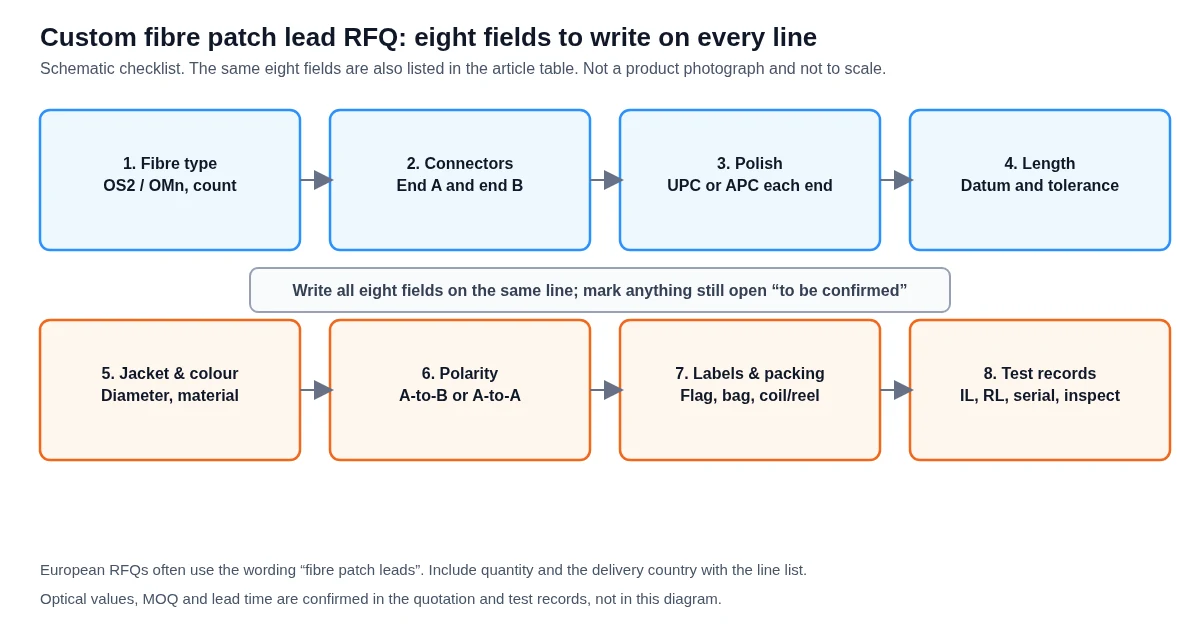
The diagram below is a schematic of the same checklist. The eight fields are written as text in the figure so the list can be read in the image itself, and they are repeated in the table above so nothing important lives only in a picture.
Fibre Type, Count and Why It Must Be Written
Fibre type must match the type of fibre in the cable plant. The Fiber Optic Association (FOA) patchcord guidance is direct: use 50/125 patchcords only with 50/125 plant and 62.5/125 only with 62.5/125 plant, and treat single-mode mode-field diameter as a match item on long-distance or special fibres.
On a European RFQ, write a recognised designation rather than a marketing nickname:
- Single-mode: OS2, and the ITU-T fibre recommendation if you need it (G.652.D, or G.657.A1 / A2 where tight bends are expected). Our G.652.D vs G.657 guide compares those families.
- Multimode: OM3, OM4 or OM5, with the core diameter implied by that grade (50/125). If a legacy 62.5/125 (OM1) run still exists, say so explicitly.
- Count and construction: simplex, duplex zip-cord, or another stated count. Uniboot duplex is a construction, not a fibre type; name both.
Bend-insensitive single-mode (G.657) is widely used in tight trays and FTTH indoor leads. FOA notes that manufacturers have generally adapted bend-insensitive designs for compatibility with standard single-mode, but you should still write the recommendation you want rather than assuming the factory will guess.
Connectors and Polish at Each End
Name the connector interface on end A and end B. “LC duplex” is not the same as “LC uniboot”, and “SC” is not complete until you add UPC or APC. If the panel and the equipment use different interfaces, order a hybrid lead and write both ends in full, for example “LC/UPC to SC/APC”. Our fiber optic connector types guide is the place to identify the port before you fill this field.
Polish is a separate field. FOA’s patchcord page tells buyers to choose PC / ultra PC or angled PC (APC) to match the system, and not to mix PC and APC connectors because that may damage them. For a short comparison of when each polish is used, see APC vs UPC.
If a project specification names an IEC 61753-1 performance grade, write the grade on the RFQ and ask the factory to state, in the quotation, how that grade will be demonstrated. This page does not assign a default grade or publish insertion-loss figures as Lumafyn product data.
Length, Tolerance and Polarity
Write the length between a datum you define (usually the connector reference faces) and the tolerance you will accept. Do not assume a factory house tolerance. A lead that is too short cannot be pulled to fit; a lead that is too long needs slack storage in the cabinet or tray.
State the unit (metres are usual on European RFQs) and whether the length is the optical path, the jacket length or another measure. If you need a breakout or furcation length on an MPO or multi-fibre assembly, write that as its own field; those products have their own guides for MPO/MTP trunk cables and breakout vs harness vs cassette.
Polarity belongs on the same line. For duplex patch leads the usual default is A-to-B (sometimes called a crossover or crossing pair, depending on local habit). A-to-A is used in specific method-A channels. If you use uniboot leads with a reversible polarity feature, say whether the lead should ship in the default or the reversed state. Our A-to-B vs A-to-A polarity guide walks through the duplex case.
Jacket, Colour and Fire Performance
Write the jacket diameter, the material and the colour. Indoor European projects often specify an LSZH (low-smoke, zero-halogen) jacket; that is a material family, not a fire-test result on its own. If the project specification names a CPR Euroclass, copy that class onto the RFQ and ask for the declaration reference to be confirmed in the quotation. We do not claim a Euroclass, and we do not publish a Declaration of Performance on this page. The CPR Euroclass fibre cable guide explains the classes; the jacket materials guide separates LSZH from other designations.
Jacket colour is a handling aid. Yellow is widely used for single-mode, aqua for OM3/OM4, and other colours appear in European plant (including Erika-violet OM4 in some networks). Write the colour you want, and use our fibre patch lead colours guide for jacket and connector colour conventions. Colour does not replace the fibre type field.
Labels, Packing and Test Records
Receiving teams match the flag or wrap label to the purchase line. Write what must appear on the lead: part number or line ID, length, fibre type, connectors and, if you use them, a serial number that matches a row on the test report. Our patch cord packing and label guide covers bag, carton and coil marks in more detail.
Say whether leads should be coiled or reeled, how they should be bagged, and whether packing is split by country or by site. Some European distributors ask for coils below a stated length and reels above it; if you have such a rule, write the threshold. It is a packing preference, not a factory default on this page.
For test records, name the measurements (insertion loss and return loss are the usual pair), the wavelengths, and whether each lead is serialised. End-face inspection against IEC 61300-3-35 is common practice; write the method if your acceptance procedure requires it. How to read the report itself is covered in how to read a patch cord test report. A factory report does not replace inspecting and cleaning LC or SC ends on site; see how to clean LC and SC connectors. Limits that apply to your order are those confirmed in the quotation, not example numbers on a public guide.
A Worked RFQ Line (Illustrative)
The line below is illustrative. It is not a real order, not a Lumafyn part number, and not an offer of price, MOQ or lead time.
| Field | Example entry |
|---|---|
| Line ID | EU-CPL-014 (illustrative) |
| Description | Duplex fibre patch lead, LSZH |
| Fibre | OS2, G.657.A1, 2 fibres (duplex) |
| End A | LC/UPC duplex, beige clip if you use one, blue boot |
| End B | SC/UPC duplex, blue boot |
| Length | 3.0 m between connector reference faces, tolerance to be confirmed in the quotation |
| Jacket | 2.0 mm LSZH, yellow |
| Polarity | A-to-B |
| Labels | Flag label: line ID, 3.0 m, OS2, LC/UPC–SC/UPC, serial number |
| Packing | Individual bag, coil, 10 leads per inner carton, country mark: DE |
| Test records | IL and RL at 1310 nm and 1550 nm, serialised to the label; end-face inspection method to be confirmed |
| Quantity | To be confirmed |
Two details in that example are left “to be confirmed” on purpose: the length tolerance and the inspection method. Those are order-specific. Putting a placeholder number on a public page would look like a factory specification, which this is not.
Common Mistakes When Specifying Fibre Patch Leads
These are the gaps we see most often when reviewing a line list, written as checks you can run before you send the RFQ:
- Connector named, polish omitted, so a UPC boot arrives on an APC port — or the other way around.
- Only one end described on a hybrid lead.
- Fibre grade omitted on multimode (“aqua LC lead”) so OM3 and OM4 are treated as interchangeable.
- Length written without a datum or a tolerance.
- Polarity left blank on duplex or uniboot leads.
- Fire performance copied from a different country’s specification, or assumed from the letters “LSZH” alone.
- Label text not matching the line ID the warehouse will scan.
- Test records requested as “standard” with no wavelengths or serialisation rule.
For buyers also comparing factory-terminated trunks with splicing on site, use the separate guide to pre-terminated fibre vs field termination. That page is about trunks and field splices, not about filling a patch-lead RFQ.
European buyers who want a single supplier conversation for patch leads, MPO assemblies and FTTH parts can start from the fibre optic supplier for Europe page and attach this checklist to the RFQ.
FAQ
Custom Fibre Patch Lead RFQ FAQ
What should I include in an RFQ for custom fibre patch leads?
Write the fibre type and count, the connector and polish at each end, the length and tolerance, the jacket material, diameter and colour, the polarity, the label and packing text, and the test records you will accept, plus quantity and delivery country.
Is a “fibre patch lead” the same product as an American patch cord or jumper?
Yes. Fibre patch lead is the usual British wording for a short factory-made jumper with connectors on both ends; the American names are patch cord and jumper. Use the wording your buyers use, and still fill every field on this checklist.
Do I need to specify polarity on every duplex lead?
Yes, even when you want the common A-to-B default. A blank polarity field is how A-to-A leads and reversed uniboot leads appear in a shipment that was expected to be straight through.
Can I specify a CPR Euroclass on the RFQ?
If the project specification names a Euroclass, copy that class onto the RFQ and ask the factory to confirm the declaration reference in the quotation. This page does not claim a Euroclass or publish a Declaration of Performance.
Will you quote from this checklist alone?
Yes. Send the completed checklist, or your own line list that covers the same fields, to the custom patch cord page or the contact form on this page. Optical values, MOQ and lead time are confirmed in the quotation and the test records, not on this guide.
Sources and Further Reading
- FOA: Patchcords for fiber optic cable systems (fibre type, jacket colour, connectors and polish)
- FOA: Fiber optic cables (tight buffer, zip-cord and jacket constructions used for patch leads)
- FOA glossary: jumper cable (connectors on both ends)
- ITU-T G.657 (bend-insensitive single-mode fibre recommendations)
- ITU-T G.652 (standard single-mode fibre recommendations)
- FOA: loss budget (TIA-568 maximum acceptable connector loss and typical values; not Lumafyn specifications)
Standards and public references describe definitions and industry practice; they are not Lumafyn product data. Optical values, MOQ and lead time for your order are confirmed in your quotation and test records.