
Connector grades
Grade B vs Grade C Fibre Connectors under IEC 61753-1
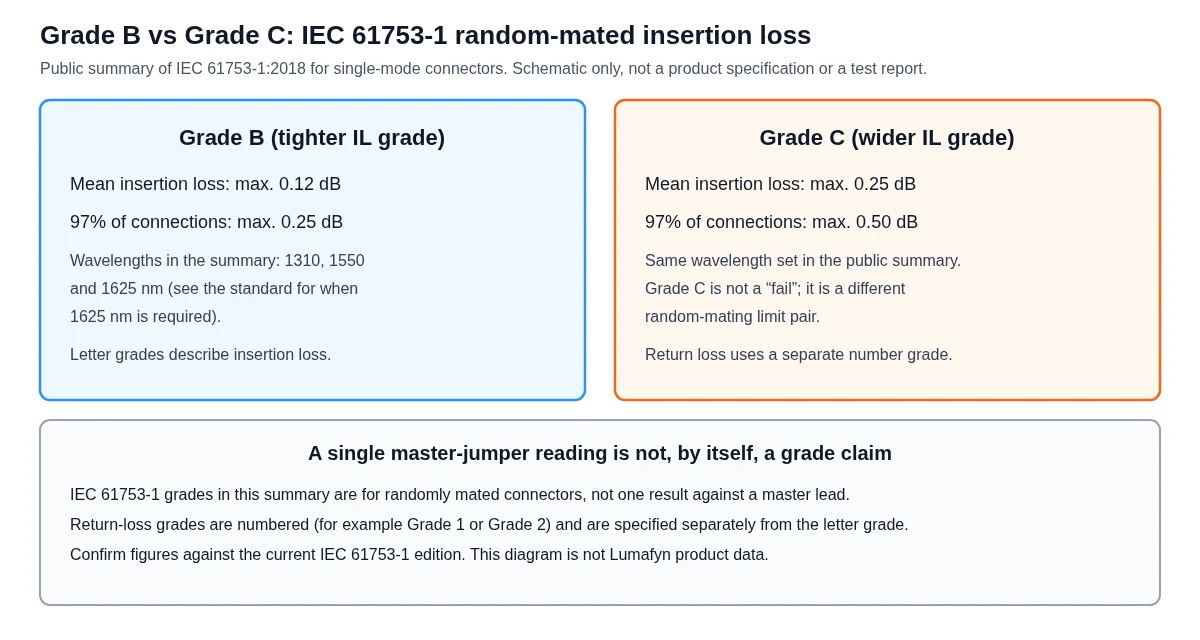
Grade B vs Grade C fibre connectors is a comparison of IEC 61753-1 insertion-loss grades for randomly mated single-mode connectors, not a comparison of two connector shapes and not a reading from one shipping report. A public summary of IEC 61753-1:2018, opened on 18 November 2026, lists Grade B as a maximum mean of 0.12 dB with at least 97% of connections at or below 0.25 dB, and Grade C as a maximum mean of 0.25 dB with at least 97% at or below 0.50 dB. Those figures describe a statistical random-mating population. A single insertion-loss line on a test report is useful, but it does not, by itself, prove a grade.
Published 2026-11-19 · Last reviewed 2026-11-19 · By the Lumafyn Technical Team
Lumafyn products are made at an ISO 9001 / ISO 14001 / ISO 45001 certified production base (management-system certificates issued by NOA). The certificates cover the production base, not individual products.
View certificates →What is the difference between Grade B and Grade C?
The practical difference is the insertion-loss window allowed when connectors are mated at random, not a change of housing, colour or ferrule brand.
| Point | Grade B | Grade C |
|---|---|---|
| What it names | An insertion-loss grade for randomly mated connectors | A wider insertion-loss grade for randomly mated connectors |
| Mean insertion loss (public summary of IEC 61753-1:2018) | Maximum 0.12 dB | Maximum 0.25 dB |
| Limit for at least 97% of connections | Maximum 0.25 dB | Maximum 0.50 dB |
| Wavelengths quoted in that summary | 1310 nm, 1550 nm and 1625 nm | The same set |
| What it does not, by itself, fix | The return-loss grade, the polish, or one factory reading against a master lead | The return-loss grade, the polish, or one factory reading against a master lead |
Those attenuation figures were taken from Telegärtner’s public article Fiber optic connector grades according to standards, opened on 18 November 2026, which presents them as performance grades of randomly mated fibre-optic connectors specified by IEC 61753-1:2018 and its European issue EN IEC 61753-1. The official IEC text was not opened for this guide, so buyers should confirm the numbers, the 1625 nm rule and any later amendments against the current edition of the standard. The same article notes that testing at 1625 nm is optional for enterprise applications but mandatory for carrier applications in that 2018 summary, and that Grade A remains for further study.
Grade C is not a failed Grade B. It is a defined, wider grade. A project that needs the tighter random-mating window should write Grade B, then say how compliance will be shown. A project that only needs Grade C should write Grade C, rather than hoping a supplier will guess.
Are the letter grades the same as return-loss grades?
No. In the same public summary, insertion loss uses a letter grade and return loss uses a number grade. The two are specified separately and then written together, for example B1 or C2, when a project needs both.
For single-mode connectors, that summary lists Grade 1 as a minimum of 60 dB when mated and 55 dB unmated, Grade 2 as a minimum of 45 dB, Grade 3 as 35 dB and Grade 4 as 26 dB, again at 1310 nm, 1550 nm and 1625 nm. Angled polish is the usual way to reach the Grade 1 window; a UPC finish is more often associated with Grade 2. Those pairings are practical, not automatic: the specification should still name both the letter and the number, and the polish.
How to read the insertion-loss and return-loss lines on a shipping report is already covered in our guide to reading a fibre patch lead test report. This article does not repeat that line-by-line method. It answers a different question: what Grade B and Grade C mean as specification language, and why a single report line is not the same thing as a random-mating grade.
Does one shipping test report prove Grade B?
Not by itself. Factory reports are often made against a master or reference lead under a controlled method such as IEC 61300-3-4. That is a useful check of the assembly you have just bought. IEC 61753-1 grades, in the summary cited above, describe a random-mating population, which is closer to what happens in a cabinet when two ordinary connectors meet in an ordinary adaptor.
IEC 61300-3-34 is the measurement procedure commonly cited for attenuation of randomly mated connectors. This guide does not open that procedure or reproduce its sample sizes. The practical point for a buyer is simpler: if you ask for Grade B, say whether you want a design-qualification or sample random-mating statement, or only a per-lead report against a reference jumper, and keep those two results distinct on the paperwork.
A low reading against a master lead can still sit inside a wider random-mating distribution. Conversely, a Grade B claim without a stated method is hard to verify. End-face quality still matters in either case: geometry and cleanliness affect both the reference measurement and later random mating, which is why inspection belongs on the same order as the optical values.
What should you write on a European specification?
Write the insertion-loss grade, the return-loss grade, the polish, the fibre, the connectors and how the values will be shown. Do not leave “low loss” as the only optical sentence.
| Line | Example wording |
|---|---|
| Optical grade | Single-mode connectors, IEC 61753-1 Grade B (insertion loss) and Grade 2 (return loss), or Grade B1 if APC is required |
| Polish | LC/UPC or LC/APC, SC/APC, as the drawing; do not mix UPC and APC on the same interface |
| Fibre and lead | OS2, ITU-T G.657.A1 or G.652.D as required, length and jacket as the drawing |
| Evidence | Insertion loss and return loss at 1310 nm and 1550 nm on the test records for each lead, plus end-face inspection; random-mating evidence only if the project asks for it and the method is agreed |
| What not to write | “Grade B” with no return-loss grade, no method and no wavelengths |
Standard leads are quoted from the fibre patch cord wholesale range. Non-standard lengths, labels or mixed connectors go through the custom fibre patch cord page. European delivery context sits on the Europe fibre optic supplier page.
US catalogues may list the same assembly as a fiber patch cord. The British project term is usually fibre patch lead. In either language, write the grade pair and the test method, rather than hoping the word “low loss” will carry the specification.
Optical values for a specific order are confirmed on the quotation and the test records. This article does not add product certifications, a minimum order or a lead time, and it does not claim that Lumafyn assemblies are already qualified as Grade B or Grade C.
Do the same letters apply to multimode connectors?
The same standard family uses letter grades for multimode connectors, but the numbers are not the same as the single-mode table. The Telegärtner summary of IEC 61753-1:2018 lists Grade Bm as a maximum mean of 0.3 dB with at least 97% of connections at or below 0.6 dB at 850 nm, and Grade Cm as a maximum mean of 0.5 dB with at least 97% at or below 1.0 dB. Grade Am and Grade Dm are listed for further study. Multimode return-loss Grade 2m is given as a minimum of 20 dB; Grade 1m is for further study.
If a bill of quantities says only “Grade B” on a multimode lead, ask whether the single-mode table or the multimode table is intended. Write Bm or “multimode Grade B” when the plant is OM3, OM4 or OM5, and name 850 nm on the test records.
What mistakes should you avoid when specifying Grade B or Grade C?
Most problems come from treating a grade as a marketing adjective, or from mixing up a reference measurement with random mating.
- Writing only “Grade B” without a return-loss grade, polish, wavelengths or method.
- Treating one master-jumper insertion-loss result as a random-mating grade, or the reverse: rejecting a sound reference report because it is not a Grade B certificate.
- Copying single-mode limits onto multimode leads, or omitting the m suffix when the table is multimode.
- Assuming APC automatically equals Grade B. APC is about return loss; the letter grade is about insertion loss.
- Asking for Grade A as if it were a current, fully defined production grade in the 2018 summary, where Grade A is still listed for further study.
If the official standard text your contract uses is a later amendment than IEC 61753-1:2018, follow that edition. This guide is a reading aid, not a substitute for the standard.
FAQ
Grade B vs Grade C FAQ
What is the difference between Grade B and Grade C connectors?
In the public summary of IEC 61753-1:2018 used here, Grade B is the tighter single-mode insertion-loss grade (mean no more than 0.12 dB, with at least 97% of random connections at or below 0.25 dB). Grade C uses 0.25 dB and 0.50 dB for those two limits. Confirm the figures in the current standard.
Does a low insertion-loss value on a test report mean the lead is Grade B?
Not automatically. Many shipping reports are measured against a master or reference lead. IEC 61753-1 grades in this summary describe randomly mated connectors. Ask for the method if you need a grade claim, and keep the per-lead report as well.
Is Grade C a failed Grade B?
No. Grade C is a defined, wider insertion-loss grade. Write the grade the design actually needs, together with the return-loss grade and the polish.
How should Grade B or Grade C appear on a specification?
Name the insertion-loss letter, the return-loss number, the polish, the fibre and the evidence you want (per-lead test records, and random-mating evidence only if agreed). Do not leave “low loss” as the only optical sentence.
Do return-loss grades use the same letters?
No. The public summary uses letters for insertion loss and numbers for return loss, for example Grade 1 or Grade 2. A complete call-out often combines them, such as B2 or B1.
Are these figures Lumafyn product limits?
No. They are industry grade limits as summarised from IEC 61753-1:2018 in a public article opened for this guide. Values for an order are confirmed on the quotation and the test records.
Sources and Further Reading
- Telegärtner, Fiber optic connector grades according to standards (public summary of IEC 61753-1:2018; opened 18 November 2026)
- Lumafyn: how to read a fibre patch lead test report (insertion loss, return loss and report method)
Standards and public references describe definitions and industry practice; they are not Lumafyn product data. Optical values, MOQ and lead time for your order are confirmed in your quotation and test records.