
Buyer Guide · United States
Fiber Optic Connector Types: LC, SC, FC, ST, MPO and VSFF Explained
The fiber optic connector types you will meet on U.S. projects are LC, SC, FC, ST, MPO and the newer very small form factor (VSFF) family. LC uses a 1.25 mm ferrule and a latch; SC, FC and ST all use a 2.5 mm ferrule but couple by push-pull, thread and bayonet respectively; MPO puts 12 or 16 fibers in one ferrule (FOA). CS, SN and MDC shrink the duplex connector for high-density panels and transceivers. Match the connector to the equipment port first, then pick the polish. After the connector is chosen, match the fibre type and wavelength to the module; see matching SFP wavelengths and patch cords.
Published 2026-11-15 · Last reviewed 2026-11-15 · By the Lumafyn Technical Team
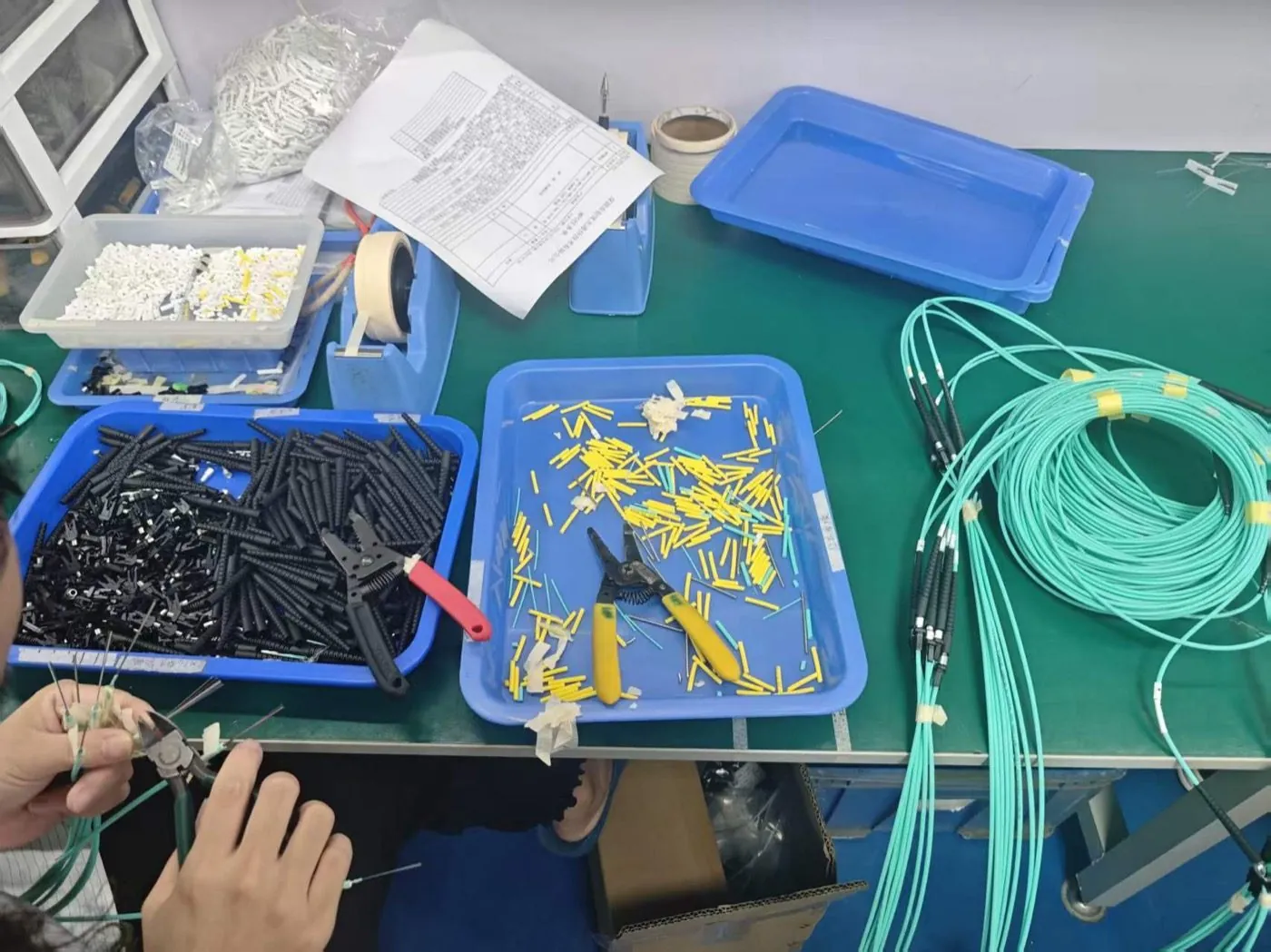
Lumafyn products are made at an ISO 9001 / ISO 14001 / ISO 45001 certified production base (management-system certificates issued by NOA). The certificates cover the production base, not individual products.
View certificates →Fiber Optic Connector Types at a Glance
Most fiber connectors differ in three things: ferrule size, coupling mechanism and fiber count. The ferrule sizes, coupling styles and FOCIS standard numbers in the table come from the Fiber Optic Association connector identifier, which notes that more than 100 connector designs have been introduced but only a few hold most of the market.
| Connector | Ferrule | Coupling | Fibers | TIA standard | Typical use |
|---|---|---|---|---|---|
| LC | 1.25 mm ceramic | Latch (RJ-style) | 1; duplex clip for 2 | FOCIS-10 (TIA-604-10) | SFP and QSFP optics, data center and enterprise panels |
| SC | 2.5 mm ceramic | Push-pull snap-in | 1; duplex versions | FOCIS-3 (TIA-604-3) | FTTH and PON (SC/APC), ODFs, older enterprise links |
| FC | 2.5 mm, ceramic or steel-sleeved | Threaded, keyed | 1 | FOCIS-4 (TIA-604-4) | Test equipment, older singlemode telecom |
| ST | 2.5 mm, mostly ceramic | Bayonet twist-lock | 1 | FOCIS-2 (TIA-604-2) | Legacy multimode campus and industrial links |
| MPO / MTP | Plastic MT array ferrule | Push-pull, pins and holes | 12 or 16 per row | FOCIS-5; FOCIS-18 for 16-fiber | Trunks and parallel optics (40G/100G and up) |
| CS, SN, MDC (VSFF) | Two 1.25 mm ferrules | Push-pull | 2 (duplex) | Vendor designs | High-density panels and breakout at QSFP-DD / OSFP optics |
How to Identify a Fiber Connector
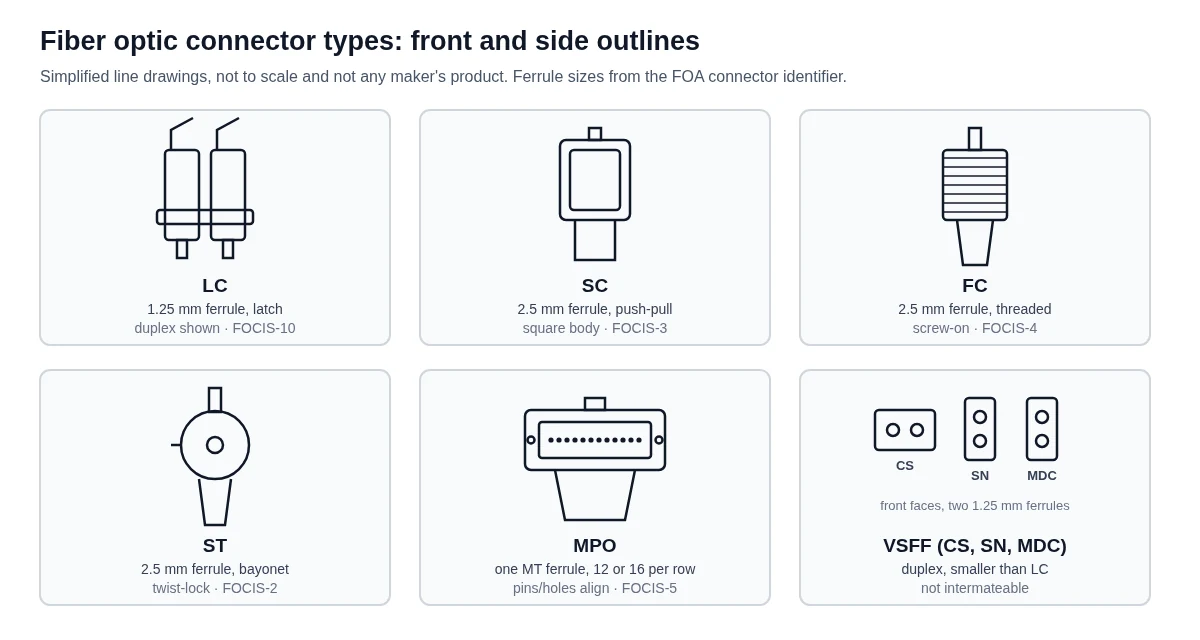
You can identify most fiber connectors by looking at the ferrule size and how the connector locks into its adapter. A thin ferrule with a plastic latch is LC; a thick ferrule in a square body is SC; a threaded metal nut is FC; a round bayonet collar is ST; a wide flat ferrule with many fibers is MPO.
Color helps with the fiber, not the connector type. The TIA-568 color code quoted by the FOA is beige for multimode, blue for singlemode and green for singlemode APC. Aqua bodies are common on OM3 and OM4 jumpers. For the polish itself, see APC vs UPC connectors; for jacket colors see patch lead colors.
LC: The Default Connector for Optics and Panels
LC is the connector you will meet most on duplex transceivers and data center panels. The FOA calls it the one small form factor connector that became a runaway success in telecom and high-speed LANs; it has a 1.25 mm ferrule, half the size of the SC, and is covered by FOCIS-10.
- Duplex LC jumpers clip two connectors together; the clip sets Tx/Rx polarity. See A-to-B vs A-to-A polarity.
- LC uniboot runs both fibers in one round cable, which saves space in dense panels; see LC uniboot patch cords.
- LC/UPC is the usual choice on data center optics; LC/APC is used where the system calls for low reflectance. See OS2 LC to LC patch cords.
SC: Push-Pull and the FTTH Standard
SC is a push-pull connector with a 2.5 mm ferrule, and green SC/APC is the usual connector in FTTH and PON networks. It was the connector standardized in TIA-568-A and is covered by FOCIS-3 (FOA).
You will still see blue SC/UPC on older enterprise patch panels and media converters. In an outside plant or carrier build, assume SC/APC unless the drawing says otherwise; an APC connector mated to a UPC connector causes high loss and can damage the end faces. See SC fiber patch cords.
FC and ST: Legacy Connectors You Still Need to Match
FC and ST are older 2.5 mm connectors that are still found on test equipment, industrial gear and campus multimode links. FC screws on with a keyed nut; ST uses a bayonet mount and was probably the most popular multimode connector until about 2005, according to the FOA.
Because ST, SC and FC share the same 2.5 mm ferrule, they can be mated with hybrid adapters, which makes it easy to build test reference cords. An LC cannot be mated to these with a simple adapter; the practical fix is a hybrid jumper such as ST-LC or FC-LC. Hybrid jumpers are built to order on our custom fiber patch cords line, with the connector on each end confirmed in your quotation.
MPO and MTP: Array Connectors for Trunks and Parallel Optics
MPO is an array connector that holds 12 or 16 fibers in a row in one plastic MT ferrule, aligned by guide pins on one side and holes on the other. The FOA lists FOCIS-5 for the 12-fiber version and FOCIS-18 for the 16-fiber version, and notes that MTP is a commercial name for an MPO-type connector.
- Trunks: MPO trunk cables carry one or more array connectors per end between panels; see MPO/MTP trunk cables.
- Parallel optics: SR4-type transceivers use MPO directly; see SR4 MPO polarity.
- Pinned or unpinned: one end of each mated pair must be pinned. State the gender on every MPO jumper or trunk you order.
- Loss: the FOA loss budget page notes that the TIA allowance of 0.75 dB per mated pair is generally too high except for MPO connectors (FOA).
VSFF Connectors: CS, SN and MDC
VSFF (very small form factor) connectors are duplex connectors that keep the LC's 1.25 mm ferrule but pack the two fibers much closer together. According to Fluke Networks, the CS spaces its fibers 3.8 mm apart and the SN 3.1 mm apart (stacked vertically), compared with 6.25 mm on a duplex LC.
| Connector | Fiber spacing | Density claim | Source |
|---|---|---|---|
| Duplex LC | 6.25 mm | Up to 96 duplex ports per 1U panel | Fluke Networks |
| CS (Senko) | 3.8 mm, side by side | 144 duplex ports per 1U panel | Fluke Networks |
| SN (Senko) | 3.1 mm, vertical | 3 times the density of LC | Fluke Networks |
| MDC (US Conec) | Vertical, slightly smaller than SN | Similar to SN; not compatible with it | Fluke Networks |
The SN was designed to give individual duplex breakout at quad transceivers such as QSFP, QSFP-DD and OSFP, as an alternative to MPO breakout (Senko application note). The connectors are not intermateable: an SN does not fit an MDC port, so the transceiver or panel decides which one you buy. If your design uses VSFF, send the connector family and the transceiver or panel part number; we confirm whether we can build the jumper before quoting.
How to Choose a Connector Type for a U.S. Project
The equipment port decides the connector, so start from the transceiver, panel or ONT and work outward. Pick polish and fiber type next, then the jacket rating for the building.
- Equipment side: read the port. Duplex SFP and QSFP optics are LC; parallel optics are MPO; PON ONTs are usually SC/APC.
- Panel side: match the adapters already installed. Mixing ST or FC legacy panels with LC optics calls for hybrid jumpers.
- Polish: UPC or APC on each end, written separately.
- Fiber: OS2, OM3, OM4 or OM5; see OM4 vs OM5.
- Jacket: riser (OFNR) for vertical shafts and plenum (OFNP) for air-handling spaces, as defined in NEC Article 770; our jacket guide explains the difference. Confirm the cable marking your inspector requires before ordering.
- Length and labels: exact length, and labels at both ends if the jumpers go into a documented panel.
| Field | Example |
|---|---|
| Project | Enterprise data center refresh, integrator in Texas |
| Jumpers | 200 x LC-LC duplex OS2 UPC, 3 m; 40 x ST-LC duplex OM3 hybrid, 2 m |
| Trunks | 6 x 12-fiber MPO OM4 trunks, pinned/unpinned per drawing |
| Jacket | Riser (OFNR) for the shaft runs, as specified by the contractor |
| Documents | Labels both ends; insertion loss per jumper |
| Price, MOQ, lead time | Confirmed in your quotation |
For how we work with U.S. distributors and contractors, see fiber optic patch cord supply for the U.S.
How We Build and Inspect Connectorized Jumpers
Our jumpers are terminated, polished and end-face inspected in our own factory before packing. The connector type, polish and fiber you order are confirmed line by line in your quotation, and insertion loss and return loss results are in the test records sent with each batch.
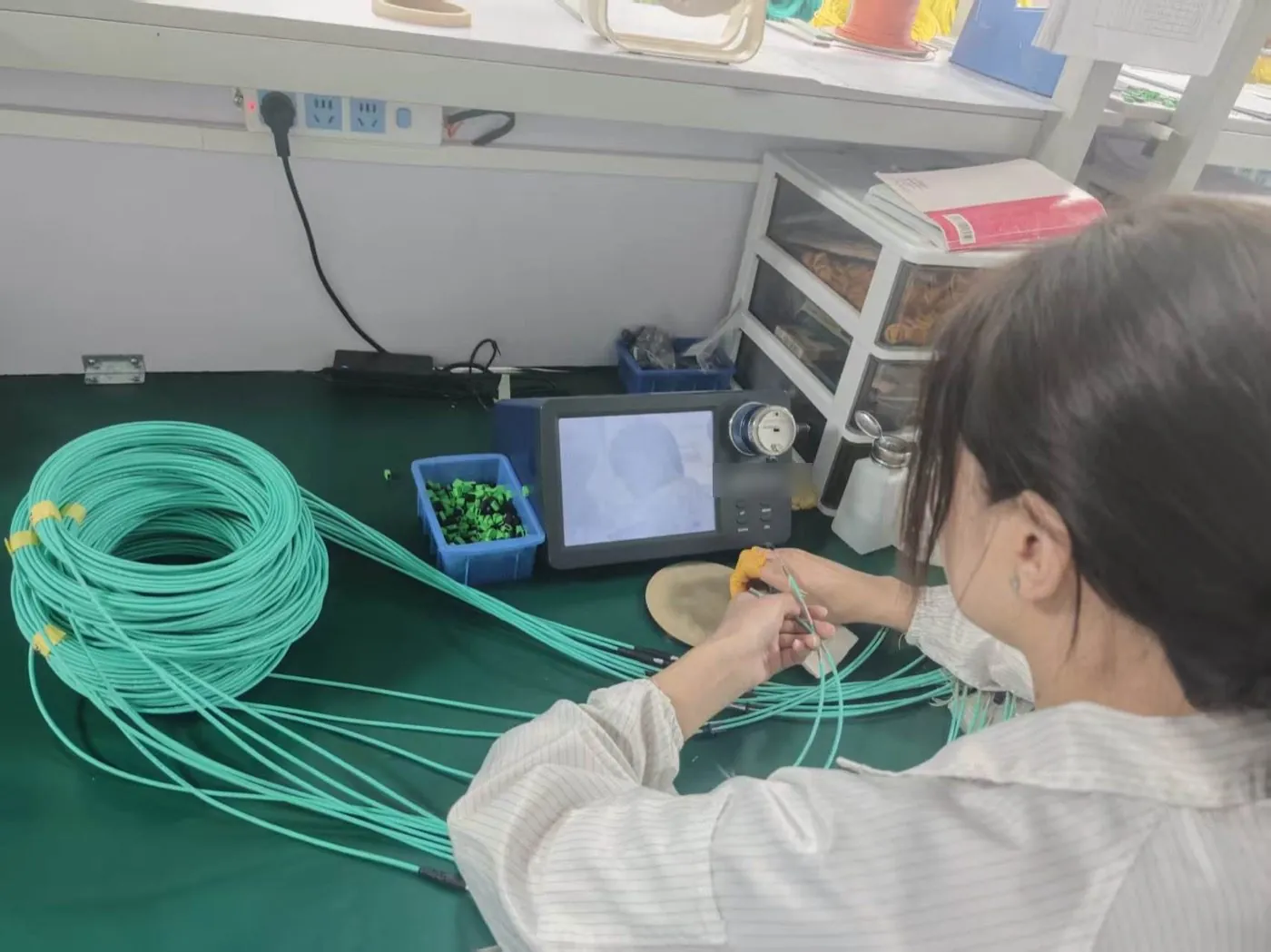
If you are comparing suppliers, our guide on how to read a patch cord test report shows what each value means.
FAQ
Fiber Optic Connector Types FAQ
What are the most common fiber optic connector types?
LC, SC and MPO are the most common on new networks. LC dominates transceivers and data center panels, SC/APC dominates FTTH, and MPO is used for trunks and parallel optics. FC and ST are mostly legacy.
What is the difference between LC and SC connectors?
LC has a 1.25 mm ferrule and a latch; SC has a 2.5 mm ferrule and a push-pull snap-in body. LC takes about half the panel space, so it suits dense racks and SFP optics.
Can you connect an LC to an SC connector?
Not with a simple adapter, because the ferrules are different sizes. Use a hybrid jumper with LC on one end and SC on the other.
What is a VSFF connector?
A very small form factor duplex connector, such as CS, SN or MDC. It uses the same 1.25 mm ferrule as LC but places the fibers closer together for higher panel and transceiver density.
Are MPO and MTP the same?
MTP is a commercial name for an MPO-type connector. Both use a multi-fiber MT ferrule; check pin gender, fiber count and polarity before mixing brands.
Sources and Further Reading
- Fiber Optic Association: fiber optic connector identifier
- Fluke Networks: what you should know about VSFF connectors
- Senko: CS and SN connector application note (PDF)
- Fiber Optic Association: loss budget and connector loss
Standards and public references describe definitions and industry practice; they are not Lumafyn product data. Optical values, MOQ and lead time for your order are confirmed in your quotation and test records.