
Buyer Guide · FTTH
FAT vs ODP vs ODC vs OTB: FTTH Box Names Explained for Southeast Asia
FAT, ODP, ODC and OTB are names for the passive boxes in an FTTH network, and several of them describe the same job. An ODC (or FDH) is the street cabinet where the feeder cable meets distribution cables, usually with the first splitter. A FAT, called ODP in Indonesia, is the last box before the drop cables to homes. An OTB is a small termination box, used in buildings or at the customer end. Whatever the label, the box's position in the network tells you what it does.
Published 2026-11-15 · Last reviewed 2026-11-15 · By the Lumafyn Technical Team

Lumafyn products are made at an ISO 9001 / ISO 14001 / ISO 45001 certified production base (management-system certificates issued by NOA). The certificates cover the production base, not individual products.
View certificates →FTTH Box Names at a Glance
FTTH boxes are named by job: termination, distribution, or access to the drop cables. The same box can carry a different name in Jakarta, Manila or Kuala Lumpur, so a bill of materials should describe the job and the contents, not only the acronym.
| Name | Stands for | Where it sits | Cables in and out | Usually inside |
|---|---|---|---|---|
| ODF | Optical distribution frame | Central office or OLT room | OLT cords in, feeder cable out | Adapters, pigtails, splice trays |
| OTB | Optical termination box | Building riser, small room, or the customer end | Small cable counts; drop cable at the home | Adapters, pigtails, splices |
| ODC / FDH / FDT | Optical distribution cabinet / fiber distribution hub | Street cabinet, pole, pad or wall | Feeder in, distribution cables out | First-stage splitters, splice trays, adapters |
| FAT / ODP / NAP | Fiber access terminal / optical distribution point / network access point | Pole, wall, handhole or riser near the homes | Distribution in, drop cables out | Second-stage splitter or splices, SC/APC adapters |
| Closure | Splice closure (joint closure) | Aerial or underground along the route | Cable in, cable out | Splices only |
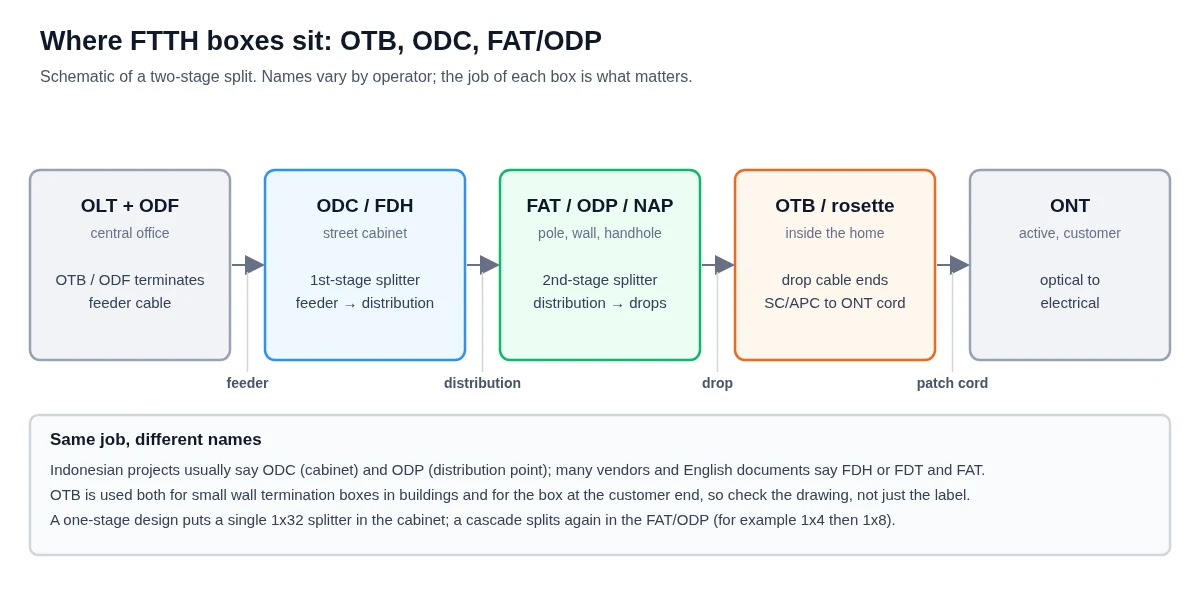
Where Each Box Sits Between the OLT and the Home
Every FTTH network has the same three cable segments: feeder, distribution and drop, and the boxes sit where one segment hands over to the next. The Fiber Optic Association describes a feeder cable running from the OLT in the central office to a fiber distribution hub where the PON splitter is housed, then distribution cables toward subscribers, and drop cables for the final link to the ONT.
- Central office: the OLT ports are patched on an ODF to the outgoing feeder.
- Feeder to distribution: an ODC or FDH cabinet, often with the first splitter.
- Distribution to drop: a FAT or ODP, the box technicians open most often.
- At the home: the drop ends in an OTB, rosette or wall outlet, and a short patch cord goes to the ONT.
ODC vs FDH: The Street Cabinet
An ODC (optical distribution cabinet) and an FDH (fiber distribution hub) are the same thing: the cabinet where the feeder cable is split or cross-connected into distribution cables. Indonesian FTTH studies define the ODC as the termination point of the feeder cable and the starting point of the distribution cable (JSCR, 2024), which matches the FDH in the FOA model.
The cabinet normally holds the first splitter stage. In a centralized design it holds the only splitter: the CommScope FTTH architecture white paper describes a 1x32 splitter in the FDH connected by a single fiber to the OLT, with 32 fibers routed on to 32 homes. Some vendors call the same cabinet an FDT (fiber distribution terminal).
FAT vs ODP: Same Job, Different Names
A FAT and an ODP do the same job: they connect distribution fibers to the individual drop cables, usually with a second-stage splitter inside. Indonesian research describes the ODP as the termination point of the drop cables toward customers (JSCR, 2024) and as the final branch before each client (J3EIT, 2024).
English-language vendor documents more often say FAT (fiber access terminal) or simply terminal box, and some operators use NAP (network access point). Whatever the name, check four things on the drawing:
- Ports: how many drop cables the box serves.
- Splitter: whether it holds a splitter (and which ratio) or only splices.
- Adapters: SC/APC is the norm for drops; see APC vs UPC.
- Mounting: pole, wall, strand or handhole, which sets the enclosure rating.
OTB: One Name, Two Uses
OTB (optical termination box) is the most ambiguous of the four names, because it is used both for compact termination boxes inside buildings and for the box at the customer end of the drop. An Indonesian supplier guide describes the OTB as a compact wall-mounted terminal for offices and apartments, and also shows the drop cable from the ODP entering an OTB or rosette in the customer's home (Fasser).
If an RFQ says only "OTB", ask which position is meant. A riser OTB in a building takes a distribution cable and may hold splices for several floors; a home OTB takes one drop cable and presents one SC/APC port for the ONT patch cord.
Splitter Placement: One Stage or a Cascade
Where the splitters go decides which boxes hold them. In a centralized design the cabinet holds a single 1x32 splitter per PON port; in a cascaded design the split is shared, for example 1x32 = 4 x 8, with one stage in the cabinet and one in the FAT or ODP (CommScope).
| Design | ODC / FDH | FAT / ODP | Source |
|---|---|---|---|
| Centralized | 1x32 | Splices or connectors only | CommScope |
| Cascade, 1x32 = 4 x 8 | 1x4 | 1x8 | CommScope |
| Bandung housing design cited in J3EIT (280 customers) | 1:4 | 1:8 | J3EIT, 2024 |
| Indonesian simulation design | 1:8 | 1:16 | J3EIT, 2024 |
The theoretical split loss is the same either way for the same total ratio, but a cascade adds connection points. For splitter loss values and ratio choice see the PLC splitter ratio guide, and for full per-port quantities see the GPON ODN materials list for a 1:32 build.
What Goes Inside and Between the Boxes
The boxes are housings; most of the line items on an FTTH bill of materials are the passive parts inside and between them. Listing those parts per box makes the RFQ easier to check.
| Box | Passive parts inside or connected |
|---|---|
| ODF / OTB at the OLT | SC/APC pigtails, adapters, OLT-to-ODF SC/APC patch cords |
| ODC / FDH | PLC splitters (LGX or rack type), pigtails, adapters, splice sleeves |
| FAT / ODP | PLC splitter (often 1x8 or 1x16), SC/APC adapters or pre-terminated drop ports |
| Drop segment | FTTH drop cable, fast connectors, clamps |
| Home OTB / rosette | SC/APC adapter, ONT patch cord |
We quote the passive parts in this table, with patch cords and pigtails built in our own factory; see FTTH ODN products. This guide explains the box names only and is not a box product listing: ask before assuming an enclosure can be added to the same order.
How to Write FTTH Boxes on an RFQ
Describe each box by function, ports and contents, and keep the local name in brackets. That avoids a supplier quoting a building OTB when you meant a pole-mounted ODP.
- Name the job: "access terminal, distribution to drop (ODP)".
- Give port count and adapter type, for example 8 x SC/APC.
- State the splitter ratio and package, or "splices only".
- Give mounting and environment: pole, wall, handhole, indoor riser.
- List the passive parts separately: splitters, pigtails, cords, drop cable and fast connectors.
| Field | Example |
|---|---|
| Project | FTTH expansion, ISP contractor in Indonesia |
| Design | 1:4 at ODC, 1:8 at ODP |
| Parts | 1x4 and 1x8 PLC splitters, SC/APC pigtails and adapters, drop cable per survey |
| Cords | OLT-to-ODF SC/APC patch cords; ONT cords for expected take-up |
| Boxes | Listed by function so the BOM is complete; enclosure supply discussed separately |
| Price, MOQ, lead time | Confirmed in your quotation |
For the countries and project types we work with across the region, see fiber optic supply for Southeast Asia; for typical deployments see application scenarios.
FAQ
FTTH Box Names FAQ
What is the difference between FAT and ODP?
There is no functional difference. Both connect distribution fibers to drop cables near the homes, usually with a second-stage splitter. ODP is the common term in Indonesia; FAT is common in vendor documents.
What is an ODC in FTTH?
An optical distribution cabinet: the street cabinet where the feeder cable ends and distribution cables begin, normally with the first splitter stage. It is the same role as an FDH.
What does OTB stand for?
Optical termination box. It can mean a small termination box in a building or the box at the customer end of the drop, so confirm which one a drawing means.
Is an ODF the same as an ODC?
No. The ODF is a frame inside the central office or OLT room; the ODC is an outdoor cabinet in the field between feeder and distribution cables.
Which box holds the PLC splitter?
In a centralized design, the ODC or FDH holds a single 1x32 splitter. In a cascade, the ODC holds the first stage and the FAT or ODP holds the second.
Sources and Further Reading
- Fiber Optic Association: FTTH architectures (feeder, distribution, drop, FDH)
- CommScope: FTTH architecture overview white paper (centralized and cascaded splits)
- Journal of Scientech Research and Development (2024): ODC, ODP and OTB in an Indonesian FTTH deployment
- J3EIT (2024): FTTH network design with ODC and ODP, Kota Raya, Indonesia
- Fasser (Indonesia): ODF, OTB, ODC and ODP compared (in Indonesian)
Standards and public references describe definitions and industry practice; they are not Lumafyn product data. Optical values, MOQ and lead time for your order are confirmed in your quotation and test records.