
Multimode grades
OM3 vs OM4 Patch Cords: Reach and When to Use Each
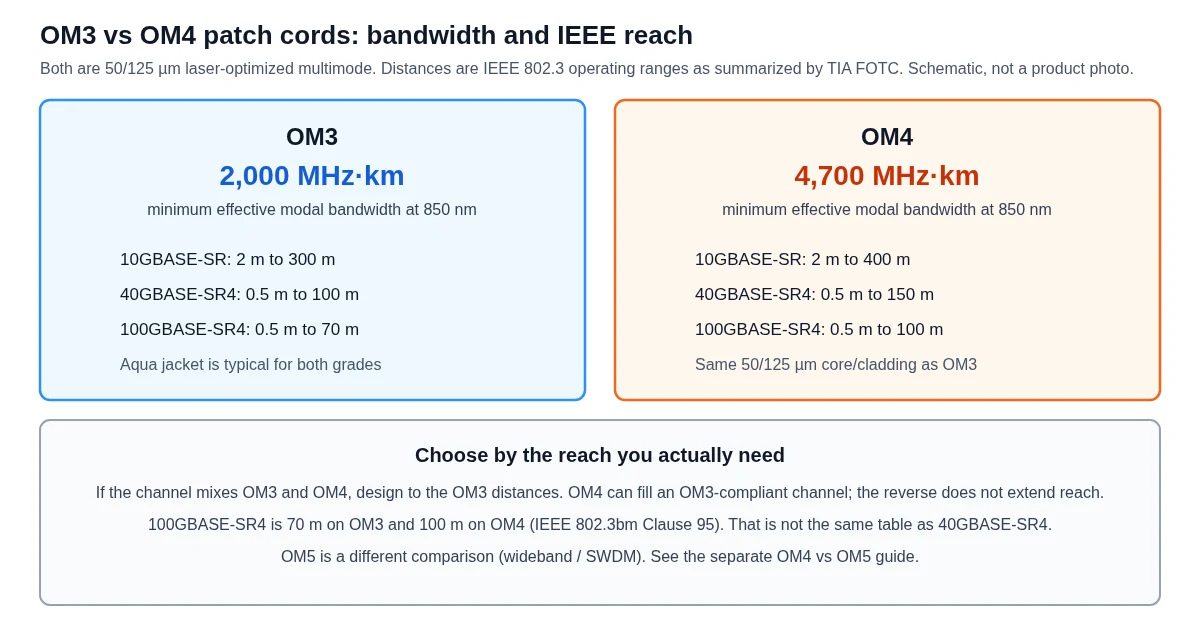
OM3 vs OM4 patch cords are both 50/125 µm laser-optimized multimode jumpers, usually in an aqua jacket, with the same connector styles. The difference that matters is bandwidth, and therefore reach: OM3 has a minimum effective modal bandwidth of 2,000 MHz·km at 850 nm; OM4 has 4,700 MHz·km. IEEE 802.3 specifies 10GBASE-SR to 300 m on OM3 and 400 m on OM4, and 100GBASE-SR4 to 70 m on OM3 and 100 m on OM4. Pick the grade for the distance you actually need; this is not the OM4 vs OM5 comparison.
Published 2026-11-18 · Last reviewed 2026-11-18 · By the Lumafyn Technical Team
Lumafyn products are made at an ISO 9001 / ISO 14001 / ISO 45001 certified production base (management-system certificates issued by NOA). The certificates cover the production base, not individual products.
View certificates →What is the difference between OM3 and OM4 patch cords?
The difference between OM3 and OM4 patch cords is effective modal bandwidth at 850 nm, not the core size, the usual jacket color, or the connector family.
| Attribute | OM3 | OM4 |
|---|---|---|
| Core / cladding | 50/125 µm, laser-optimized multimode | 50/125 µm, laser-optimized multimode |
| Minimum effective modal bandwidth at 850 nm | 2,000 MHz·km | 4,700 MHz·km |
| Typical jacket color (TIA-598 practice) | Aqua | Aqua |
| Connectors commonly used on cords | LC duplex or MPO/MTP, among others | The same families |
| What the grade does not tell you by itself | Jacket fire listing, polarity, or test limits | Jacket fire listing, polarity, or test limits |
The 2,000 and 4,700 MHz·km figures appear in the IEEE 802.3 application tables and in the TIA Fiber Optics Tech Consortium (FOTC) overviews for 10GBASE-SR and 100GBASE-SR4, opened on 17 November 2026. IEC 60793-2-10 is the multimode fiber product specification that sits under those grades (Type A1a.2 for OM3, Type A1a.3 for OM4 in the IEEE 802.3bm text).
Because the glass geometry is the same, an OM4 cord can mate to the same LC or MPO interfaces as an OM3 cord. Compatibility of the connector does not extend the reach of a channel that still contains OM3. That point is taken up below.
How far do OM3 and OM4 run at 10 Gb/s and 100 Gb/s?
Use the IEEE 802.3 operating range for the transceiver you are buying, not a vendor “engineered link” number, unless your design is explicitly an engineered channel.
| Application | Fibers | OM3 | OM4 | Standards reference |
|---|---|---|---|---|
| 10GBASE-SR | 2 | 2 m to 300 m | 2 m to 400 m | IEEE 802.3 Clause 52; TIA FOTC 10GBASE-SR overview |
| 25GBASE-SR | 2 | 0.5 m to 70 m | 0.5 m to 100 m | IEEE 802.3 Clause 112; TIA FOTC multimode table |
| 40GBASE-SR4 | 8 | 0.5 m to 100 m | 0.5 m to 150 m | IEEE 802.3 Clause 86; TIA FOTC multimode table |
| 100GBASE-SR4 | 8 | 0.5 m to 70 m | 0.5 m to 100 m | IEEE 802.3bm Clause 95; TIA FOTC 100GBASE-SR4 overview |
Two details are easy to mix up. First, 100GBASE-SR4 is not the same reach table as 40GBASE-SR4. 40GBASE-SR4 is specified to 100 m on OM3 and 150 m on OM4. 100GBASE-SR4, in IEEE 802.3bm Clause 95, is specified to 70 m on OM3 and 100 m on OM4. Second, some marketing tables quote longer 10 Gb/s distances on OM4 than 400 m. Those are typically vendor engineered-link claims, not the IEEE 802.3ae operating range of 2 m to 400 m on OM4 (TIA FOTC 10GBASE-SR page).
This article does not repeat the OM4 vs OM5 comparison. OM5 is aimed at wideband / shortwave WDM use; its 850 nm bandwidth in the IEEE tables matches OM4 for the applications above. That subject lives in the OM4 vs OM5 patch cord guide.
Can you mix OM3 and OM4 in one channel?
You can physically connect them, but you should design the mixed channel to the OM3 distances.
IEEE 802.3bm Clause 95 notes that OM4 fiber meets the requirements for OM3, so a channel written to the OM3 column may use OM4, or a mix of OM3 and OM4. The reverse is not true: inserting an OM3 cord, cassette or trunk into a run you had planned as 100 m of 100GBASE-SR4 on OM4 takes the design back to the 70 m OM3 limit. The lowest-bandwidth span sets the reach.
If a room is being recabled in stages, label the remaining OM3 segments and do not assume a new OM4 patch cord at each end will “upgrade” the middle of the channel.
When should you choose OM4 instead of OM3?
Choose OM4 when the planned application and the actual length sit beyond the OM3 operating range, or when you want one multimode grade for several future speeds in the same plant.
- Specify OM4 for 100GBASE-SR4 links longer than 70 m, up to the 100 m OM4 range; for 40GBASE-SR4 links longer than 100 m, up to 150 m; and for 10GBASE-SR links longer than 300 m, up to 400 m.
- OM3 remains a valid choice where every link sits comfortably inside the OM3 ranges — for example a 10 Gb/s row that never exceeds 300 m, or a 100GBASE-SR4 run of 50 m.
- A short cabinet jumper does not need OM4 in order to light. The grade is about the channel you are building, including trunks and cassettes, not a prestige label on a 2 m lead.
- Do not specify OM5 here unless you have a shortwave WDM or 400GBASE-SR4.2 reason. That decision is covered in the OM4 vs OM5 guide.
Jacket fire ratings (OFNR, OFNP, LSZH and so on) are a separate choice from OM3 or OM4. They are explained, without listing claims, in the LSZH, PVC, OFNR and OFNP jacket guide.
What belongs on an OM3 or OM4 patch cord line?
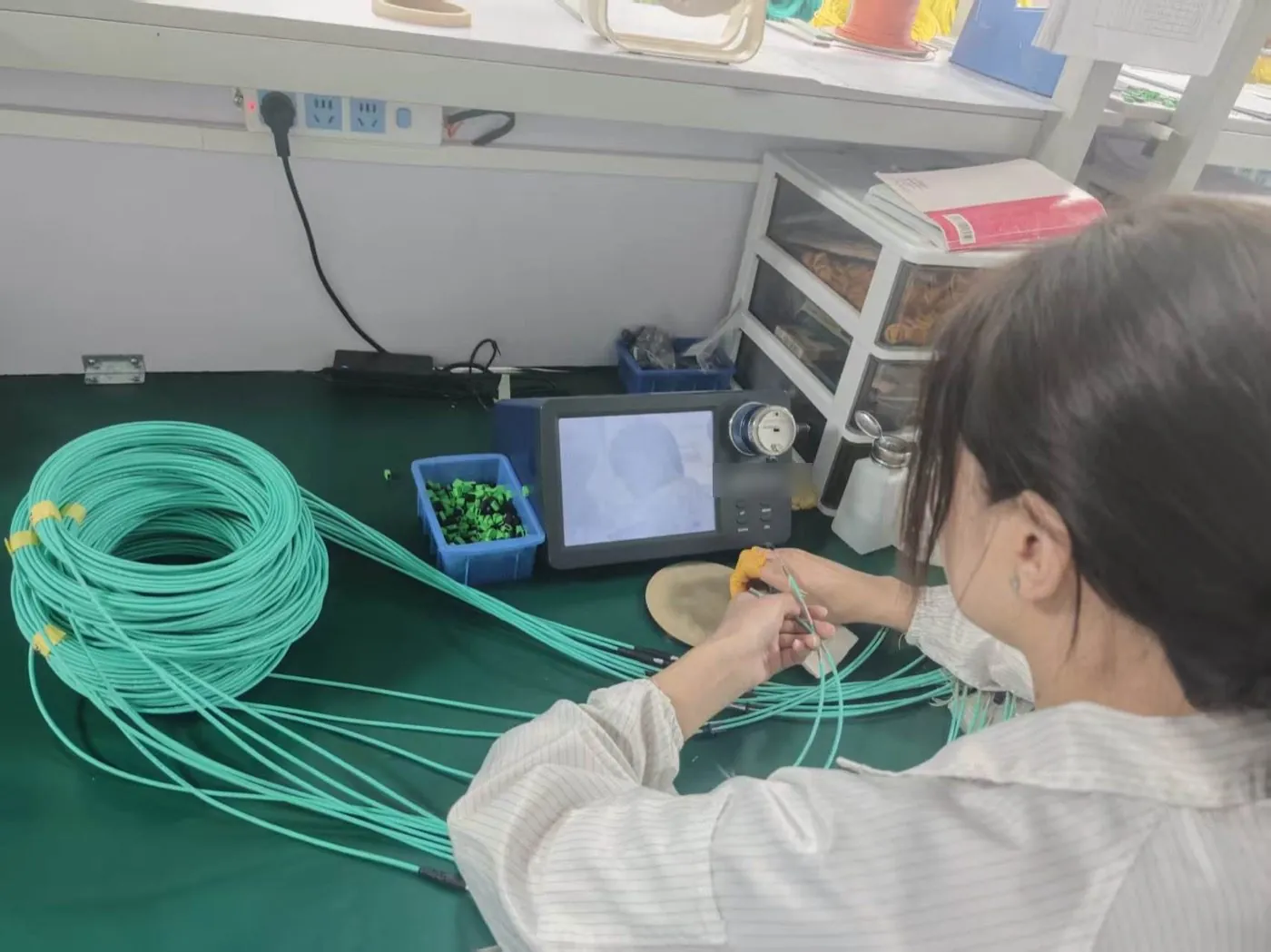
Write the grade, the connectors, the fiber count or polarity if you are using MPO, the length, and the jacket construction you need for the space.
| Field | Example |
|---|---|
| Grade | OM4 (or OM3, if every link fits the OM3 table) |
| Ends | LC/UPC duplex to LC/UPC duplex, or MPO-12 to MPO-12 with polarity stated |
| Length | 15 m, with the tolerance you actually need |
| Jacket | Aqua; name the fire construction separately if the room requires it |
| Tests | Insertion loss, and end-face inspection; values confirmed on the test records |
Standard multimode and single-mode ranges are quoted from the fiber optic patch cord wholesale page. LC-specific single-mode lines stay on the OS2 LC to LC patch cord page; this article does not take that keyword. U.S. distributor context is on the United States fiber optic supplier page.
Optical values, packing and any date or quantity limits are confirmed on the quotation and the test records for that order. This article does not add certifications, a minimum order, or a lead time.
FAQ
OM3 vs OM4 Patch Cord FAQ
Are OM3 and OM4 patch cords the same diameter?
Yes. Both are 50/125 µm laser-optimized multimode. The difference used in the IEEE tables is effective modal bandwidth at 850 nm: 2,000 MHz·km for OM3 and 4,700 MHz·km for OM4.
How far can 10GBASE-SR run on OM3 and OM4?
IEEE 802.3 Clause 52, as summarized by TIA FOTC, specifies 2 m to 300 m on OM3 and 2 m to 400 m on OM4. Longer vendor figures are typically engineered-link claims, not that operating range.
Is 100GBASE-SR4 150 m on OM4?
No. IEEE 802.3bm Clause 95 specifies 0.5 m to 70 m on OM3 and 0.5 m to 100 m on OM4. The 100 m / 150 m pair belongs to 40GBASE-SR4, not to 100GBASE-SR4.
Can I mix OM3 and OM4 in one link?
The connectors will mate, but you should design the mixed channel to OM3 distances. IEEE 802.3bm notes that OM4 meets OM3 requirements, so OM4 may be used in an OM3-compliant channel; OM3 does not extend an OM4-planned reach.
Should I buy OM5 instead of OM4?
Only if you have a reason that belongs to OM5, such as shortwave WDM. For the 10G, 40G and 100G reaches in this article, OM5 is not a substitute topic; see the OM4 vs OM5 guide.
Sources and Further Reading
- TIA FOTC: 10GBASE-SR application overview (OM3 300 m, OM4 400 m; EMB 2,000 / 4,700 MHz·km)
- TIA FOTC: 100GBASE-SR4 application overview (OM3 70 m, OM4 100 m)
- TIA FOTC: multimode Ethernet application table (including 25GBASE-SR and 40GBASE-SR4)
- IEEE P802.3bm draft excerpt, Clause 95: 100GBASE-SR4 operating range and note that OM4 meets OM3 requirements
- FOA: optical fiber types
Standards and public references describe definitions and industry practice; they are not Lumafyn product data. Optical values, MOQ and lead time for your order are confirmed in your quotation and test records.