
Single-mode categories
OS1 vs OS2 Fibre: Cabled Categories and How to Specify
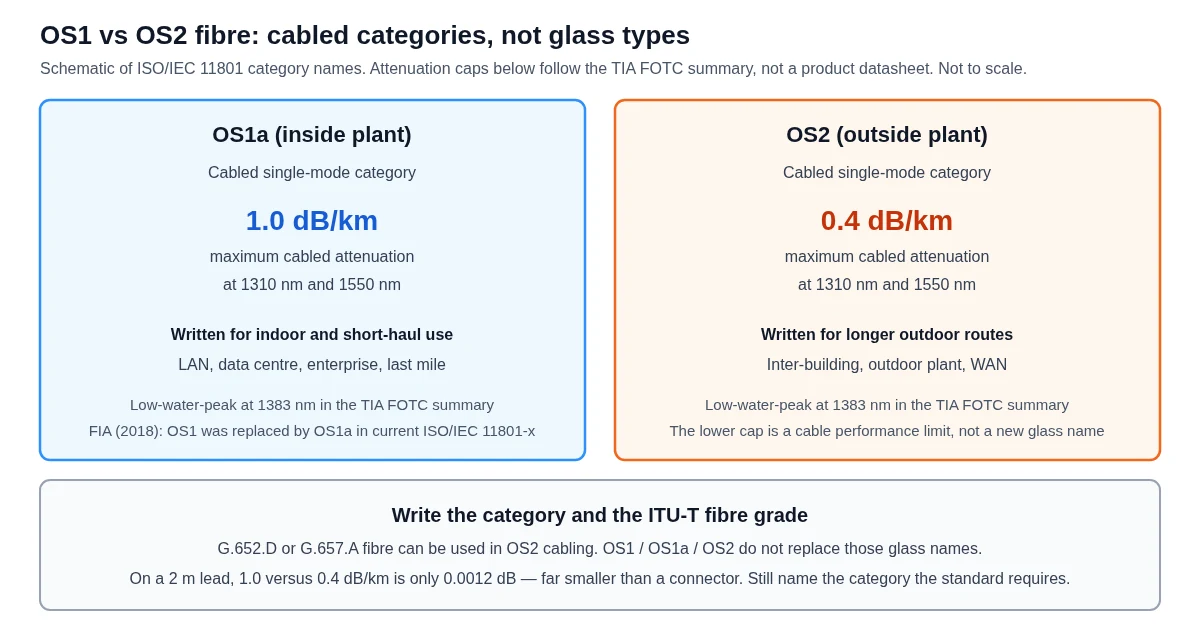
OS1 vs OS2 fibre is a comparison of cabled single-mode categories in ISO/IEC 11801 and EN 50173, not a comparison of two glass recipes. In the TIA Fiber Optics Tech Consortium summary, inside-plant OS1a is capped at 1.0 dB/km and outside-plant OS2 at 0.4 dB/km at 1310 nm and 1550 nm. The Fibreoptic Industry Association noted in 2018 that current ISO/IEC 11801-x editions replace OS1 with OS1a. Name both the category the cabling standard requires and the ITU-T fibre grade. When you also have to match that single-mode category to a module wavelength and medium, see matching SFP wavelengths and patch cords.
Published 2026-11-18 · Last reviewed 2026-11-18 · By the Lumafyn Technical Team
Lumafyn products are made at an ISO 9001 / ISO 14001 / ISO 45001 certified production base (management-system certificates issued by NOA). The certificates cover the production base, not individual products.
View certificates →What is the difference between OS1 and OS2 fibre?
The practical difference between OS1 and OS2 fibre is the maximum cabled attenuation allowed for that category, not a change of connector, jacket colour or fibre brand.
| Point | OS1a (inside plant) | OS2 (outside plant) |
|---|---|---|
| What it specifies | A cabled single-mode category | A cabled single-mode category |
| Maximum cabled attenuation (TIA FOTC) | 1.0 dB/km at 1310 nm and 1550 nm | 0.4 dB/km at 1310 nm and 1550 nm |
| Water peak at 1383 nm (TIA FOTC) | Low-water-peak: the 1383 nm cap matches the 1310 nm cap | The same low-water-peak characterisation |
| Written for (TIA FOTC) | Indoor and short-haul LAN, data centre, enterprise and last-mile use | Longer outdoor, inter-building and WAN routes |
| What it does not name | The ITU-T glass grade (G.652.D or G.657) | The ITU-T glass grade (G.652.D or G.657) |
Those attenuation figures come from the TIA FOTC overview of single-mode fibre types recommended in TIA guidance for new installations, opened on 17 November 2026. They are industry summary values for the categories, not factory test limits for a Lumafyn cable. The defining documents for the OS names themselves are ISO/IEC 11801 and, in Europe, EN 50173.
On 1 September 2018 the Fibreoptic Industry Association published The Truth About OS1 (now OS1a) and OS2, stating that OS1 was replaced by OS1a in the then-current ISO/IEC 11801-x (available as BS ISO/IEC 11801-x:2017) and EN 50173-x (BS EN 50173-x:2018). If a specification still says only “OS1”, ask whether the current OS1a text is intended.
Are OS1 and OS2 fibre glass types?
No. OS1, OS1a and OS2 name the performance of the fibre after it has been cabled, whereas ITU-T G.652 and G.657 name the optical fibre itself.
That distinction is already used on this site in the G.652.D vs G.657 fibre guide: both G.652.D and G.657.A fibres can be used in OS2 cabling, so “OS2” on a drawing does not tell you whether the glass is bend-insensitive. The present article covers the category labels; that guide covers the glass grades, including the ITU-T 08/2024 cabled-attenuation limits of 0.40 dB/km from 1310 nm to 1625 nm for those fibres.
IEC 60793-2-50 is the fibre product specification that sits under those ITU-T recommendations (for example Type B1.3 for G.652.D-type fibre and Type B6 for G.657). Buyers who only write “OS2” leave the glass type to the supplier’s default, which is a poor way to control bend radius on indoor leads and drops.
Why do short patch leads still say OS2?
Short indoor leads are often labelled OS2 because the fibre inside is usually low-water-peak single-mode fibre that can meet the tighter cabled cap, and because many buyers now treat OS2 as the default single-mode word — not because a two-metre jumper needs 0.4 dB/km to work.
The arithmetic is straightforward. At the category caps, one kilometre of OS1a cable may add up to 1.0 dB and one kilometre of OS2 cable up to 0.4 dB, a difference of 0.6 dB/km. Over a 2 m lead that difference is 0.0012 dB, which is far smaller than the insertion loss of a single connector pair. The category still belongs on the line if the cabling standard you are building to requires it; it is just not a useful way to “upgrade” a short jumper.
US catalogues may list the same short lead as a fiber patch cord. The British project term is usually fibre patch lead. In either language, write the OS category, the ITU-T grade, the connectors and the length, rather than hoping the jacket colour will carry the specification. Yellow is the usual single-mode colour under TIA-598; it does not tell you OS1a from OS2, or G.652.D from G.657.
Is every indoor cable OS1 and every outdoor cable OS2?
No. Tight-buffered indoor cable and loose-tube outdoor cable are constructions; OS1a and OS2 are attenuation categories. The two often travel together, but one does not prove the other.
A tight-buffered indoor cable can be built and tested to the OS2 cap if its cabled attenuation stays within 0.4 dB/km. A loose-tube outdoor cable that only meets 1.0 dB/km would not be OS2, even if it lives outside. CommScope discussed this tight-buffer misconception in a 22 August 2016 technical note, which is worth reading alongside the standards rather than treating construction names as category names.
The TIA FOTC overview also describes a third, indoor-outdoor single-mode option with a 0.5 dB/km cap at 1310 nm and 1550 nm. That figure is part of TIA’s installation guidance. It is not a third ISO OS label, and it should not be written on a European EN 50173 bill of quantities as if it were OS1a or OS2.
What should you write on a singlemode specification?
Write both the cabled category required by the premises standard and the ITU-T fibre grade, then the connectors, polish, jacket, diameter and length.
| Line | Example wording |
|---|---|
| Premise cable | Loose-tube single-mode, OS2, G.652.D, 12 fibre, length and route as drawing |
| Indoor backbone | Tight-buffered single-mode, OS2 (confirm the 0.4 dB/km cap if the standard requires it), G.657.A1 |
| Equipment lead | LC/UPC to LC/UPC duplex, OS2, G.657.A1, 2.0 mm, yellow, 3 m |
| Pigtail | SC/APC pigtail, G.657.A1, 900 µm, 1.5 m; add the OS category only if the cabling standard asks for it |
| Tests | Insertion loss and return loss at 1310 nm and 1550 nm, plus end-face inspection; values confirmed on the test records |
If the fibre grade is still open, write “G.657.A1 or as confirmed for the bend radius” rather than leaving a blank. Standard OS2 LC to LC patch cords are quoted on the OS2 LC to LC patch cord page. Non-standard lengths, labels or breakouts go through the custom fibre patch cord page. European delivery context sits on the Europe fibre optic supplier page.
Optical values, packing and any date or quantity limits are confirmed on the quotation and the test records for that order. This article does not add product certifications, or a minimum order, or a lead time.
What mistakes should you avoid when specifying OS1 or OS2?
The usual mistakes treat the category as if it were a glass type, a construction name, or a way to improve a short jumper.
- Writing only “OS2” and omitting G.652.D or G.657.A1/A2, so the bend-radius need is never stated.
- Assuming a yellow indoor jumper must be OS1 because it is short, or that a loose-tube cable must be OS2 because it is outdoor.
- Expecting a measurable insertion-loss gain from “upgrading” a 2 m lead from OS1a to OS2. The cap difference is 0.0012 dB on that length.
- Using OS2 as a synonym for G.657. Bend-insensitive behaviour comes from the ITU-T grade, which is explained in the G.652.D vs G.657 guide.
- Copying a North American indoor/outdoor 0.5 dB/km figure onto an EN 50173 bill as if it were an OS category.
If you already have a European bill of quantities, keep the OS wording the standard uses, add the ITU-T grade, and send the line list with the enquiry form below.
FAQ
OS1 vs OS2 Fibre FAQ
Is OS2 a different glass type from OS1 or OS1a?
No. OS1, OS1a and OS2 are cabled single-mode categories in ISO/IEC 11801 and EN 50173. The glass is named by ITU-T recommendations such as G.652.D or G.657.
Did OS1 disappear from the standards?
The Fibreoptic Industry Association stated in September 2018 that OS1 was replaced by OS1a in the ISO/IEC 11801-x:2017 and EN 50173-x:2018 editions. If a document still says OS1, confirm whether OS1a is intended.
Does an OS2 patch lead have much lower loss than an OS1a lead of the same length?
Not on a short jumper. At the published category caps the difference is 0.6 dB/km, which is 0.0012 dB over 2 m — much smaller than a connector. The category still belongs on the line if the cabling standard requires it.
Can G.657 fibre be used in OS2 cabling?
Yes. This site’s G.652.D vs G.657 guide already notes that both G.652.D and G.657.A fibres can be used in OS2 cabling. Write the ITU-T grade as well as the category.
Is every tight-buffered indoor cable OS1a?
No. Construction and category are different tests. A tight-buffered cable can meet the OS2 cap if its cabled attenuation is within 0.4 dB/km; the construction name alone does not decide the category.
Sources and Further Reading
- FIA, 1 September 2018: The Truth About OS1 (now OS1a) and OS2
- TIA Fiber Optics Tech Consortium: single-mode fibre types and attenuation caps (OS1a 1.0 dB/km, OS2 0.4 dB/km)
- ITU-T G.652 (08/2024): single-mode optical fibre and cable
- ITU-T G.657 (08/2024): bending-loss insensitive single-mode fibre
- CommScope, 22 August 2016: tight-buffered cable is not automatically OS1
- FOA: optical fiber types
Standards and public references describe definitions and industry practice; they are not Lumafyn product data. Optical values, MOQ and lead time for your order are confirmed in your quotation and test records.