
SEA fiber guide
Matching SFP Wavelengths and Patch Cords: 1310, 1550 and BiDi Pairs
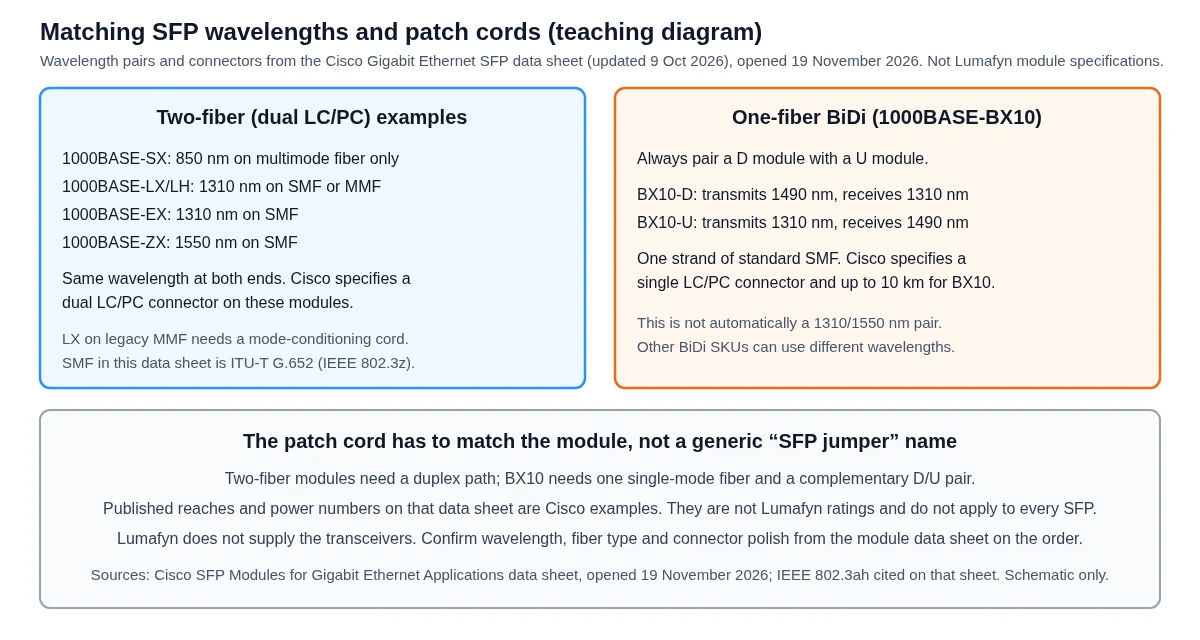
An SFP will only work over a patch cord that matches the fiber type and the wavelength plan of the modules at both ends. In a Cisco Gigabit Ethernet SFP data sheet opened on 19 November 2026, 1000BASE-SX is 850 nm on multimode, LX/LH and EX use 1310 nm, ZX uses 1550 nm, and 1000BASE-BX10 is a 1490/1310 nm pair on one single-mode fiber — not automatically 1310/1550 nm. Those figures are Cisco examples, not Lumafyn specifications, and the published reaches do not apply to every SFP. Lumafyn does not supply the transceivers.
Published 2026-11-20 · Last reviewed 2026-11-20 · By the Lumafyn Technical Team
Lumafyn products are made at an ISO 9001 / ISO 14001 / ISO 45001 certified production base (management-system certificates issued by NOA). The certificates cover the production base, not individual products.
View certificates →Why does an SFP wavelength have to match the patch cord and the far end?
An SFP will only work over a patch cord that matches the fiber type and the wavelength plan of the module at both ends. A dual-fiber 1310 nm or 1550 nm module expects the same wavelength in both directions, on the fiber type the data sheet names. A bidirectional (BiDi) module expects a complementary mate on a single fiber. If you put a multimode jumper on a single-mode 1550 nm port, or you put two “downstream” BiDi modules in the same link, the plant will not make that combination work just because both ends are labeled SFP.
This page is for access-network and ISP readers who have to match jumpers and pigtails to transceivers already specified on an order. It does not take over the 400G or 800G data-centre keyword, it does not repeat the connector-types guide, and it does not offer modules, media converters or a compatibility list of our own. Confirm every number on the data sheet of the modules actually used.
What do 850, 1310 and 1550 nm require of the cord?
In the Cisco Gigabit Ethernet SFP data sheet opened on 19 November 2026, 1000BASE-SX is an 850 nm multimode example, while 1000BASE-LX/LH and 1000BASE-EX use 1310 nm and 1000BASE-ZX uses 1550 nm on single-mode fiber — those figures are Cisco’s, not Lumafyn specifications. The data sheet, “Cisco SFP Modules for Gigabit Ethernet Applications,” updated 9 October 2026, was opened at cisco.com and states that those optical models are compatible with IEEE 802.3z for SX and LX, with the reaches below published for those Cisco SKUs.
| Cisco example | Transmit wavelength in the data sheet | Fiber the data sheet names | Published operating distance in that data sheet | Connector named in that data sheet |
|---|---|---|---|---|
| 1000BASE-SX | 850 nm | Multimode only | Up to 550 m on 50 µm MMF, 220 m on FDDI-grade 62.5 µm MMF, and up to 1 km on laser-optimized 50 µm MMF | Dual LC/PC |
| 1000BASE-LX/LH | 1310 nm | SMF or MMF | Up to 10 km on standard SMF and up to 550 m on multimode; a mode-conditioning patch cord is required on legacy multimode | Dual LC/PC |
| 1000BASE-EX | 1310 nm | SMF | Up to 40 km; a 5 dB inline attenuator is specified for back-to-back connections | Dual LC/PC |
| 1000BASE-ZX | 1550 nm | SMF | Approximately 70 km, depending on fiber quality, splices and connectors; the data sheet also gives a 21 dB optical link budget | Dual LC/PC |
The same data sheet footnotes ITU-T G.652 single-mode fiber as specified by IEEE 802.3z for those SMF rows. Category names such as OS1 or OS2, and bend-insensitive grades such as G.657, are inputs explained on the OS1 vs OS2 fibre and G.652.D vs G.657 guides. They do not change the rule that the jumper has to be the fiber type the module data sheet names.
Use those rows only as a worked example of how to read a data sheet. Another manufacturer’s “LX” or “ZX” module can differ in reach, in the allowed fiber, or in the connector polish. This article does not treat 10 km, 40 km or 70 km as a promise for every 1310 nm or 1550 nm SFP.
How do you pair BiDi modules on one fiber?
A 1000BASE-BX10 link uses one strand of single-mode fiber and a complementary pair: the D device transmits at 1490 nm and the U device transmits at 1310 nm. The Cisco data sheet opened on 19 November 2026 states that 1000BASE-BX-D and 1000BASE-BX-U SFPs are compatible with the IEEE 802.3ah 1000BASE-BX10-D and 1000BASE-BX10-U standards, that a D device is always connected to a U device, and that the D device transmits a 1490 nm channel and receives 1310 nm, while the U device transmits at 1310 nm and receives 1490 nm. The published operating range in that data sheet is up to 10 km on standard SMF.
That is not automatically a 1310/1550 nm pair. Informal pages often describe “BiDi” as 1310/1550. Some other Cisco single-fiber SKUs in the same data sheet do use different wavelengths — for example GLC-BX40-D-I transmits in the 1540–1560 nm band — but those are still Cisco examples, not a universal BiDi table and not the 1000BASE-BX10 pair. If the modules on your order are not 1000BASE-BX10, read that pair from their own data sheet.
| End of the link | Transmit (Cisco data sheet) | Receive (Cisco data sheet) | Fiber and connector in that data sheet |
|---|---|---|---|
| 1000BASE-BX10-D | 1490 nm (1480–1500 nm transmit range) | 1310 nm (1260–1360 nm receive range) | One strand of standard SMF; single LC/PC |
| 1000BASE-BX10-U | 1310 nm (1260–1360 nm transmit range) | 1490 nm (1480–1500 nm receive range) | One strand of standard SMF; single LC/PC |
Two D modules, or two U modules, do not make a BX10 link. The WDM splitter is inside the SFP in that description; the patch cord is still one single-mode fiber with a connector that matches the port. Lumafyn does not supply the D or U transceiver.
What kind of patch cord does the port actually need?
The same Cisco data sheet specifies a dual LC/PC connector on the two-fiber SX, LX/LH, EX and ZX modules, and a single LC/PC connector on the BX-D and BX-U modules; a simplex single-mode cord is what that one-fiber BX10 link needs. A duplex jumper is the usual plant for a dual-LC port. Do not assume an APC polish, or a multimode aqua jumper, will match a port that the data sheet names as LC/PC on G.652 single-mode fiber.
Other modules, including 10G BiDi and many PON optics, can use different connector polishes or different wavelength pairs. Those are outside the Cisco Gigabit Ethernet sheet opened for this article, so they are not tabulated here. Match the connector, the polish and the fiber to the data sheet of the modules on the order, and to the plant already installed. Connector families themselves are compared in the fiber optic connector types guide, which does not replace this wavelength-matching page.
Does a published reach apply to every SFP?
A published operating distance on one vendor data sheet is not a reach that applies to every SFP, and it is not a Lumafyn product rating. Cisco’s own ZX wording is already conditional: approximately 70 km, depending on fiber quality, splices and connectors. EX in that sheet is up to 40 km and calls for a 5 dB attenuator on back-to-back links. LX/LH on multimode requires a mode-conditioning patch cord on legacy multimode fiber, regardless of span length, as that data sheet footnotes.
Use the module data sheet, then add the plant’s own connectors, splices and splitters if they exist. A standardized Ethernet reach, or a vendor “up to 10 km” line, does not replace that check, and it does not become a specification for a Lumafyn jumper. We quote and test the cord; we do not assign a transceiver budget.
What should an ISP put on an RFQ?
An RFQ should list both transceiver types, both wavelengths, the fiber type, the connector and polish, and whether the plant is one fiber or two — not a request for Lumafyn to supply the modules. For a BX10-style link, name the D end and the U end explicitly. If a mode-conditioning cord is required on a legacy multimode LX span, say so. If the far end is already a pigtail in a closure, say that too; the difference between a pigtail and a patch cord is covered in the fiber pigtail vs patch cord guide.
Standard jumper ranges are listed on the fiber optic patch cord wholesale page and on the fiber pigtail page. Southeast Asia delivery context sits on the Southeast Asia fiber optic supplier page. None of those pages sells or warranties an SFP, and none of them turns the Cisco example reaches into a product rating.
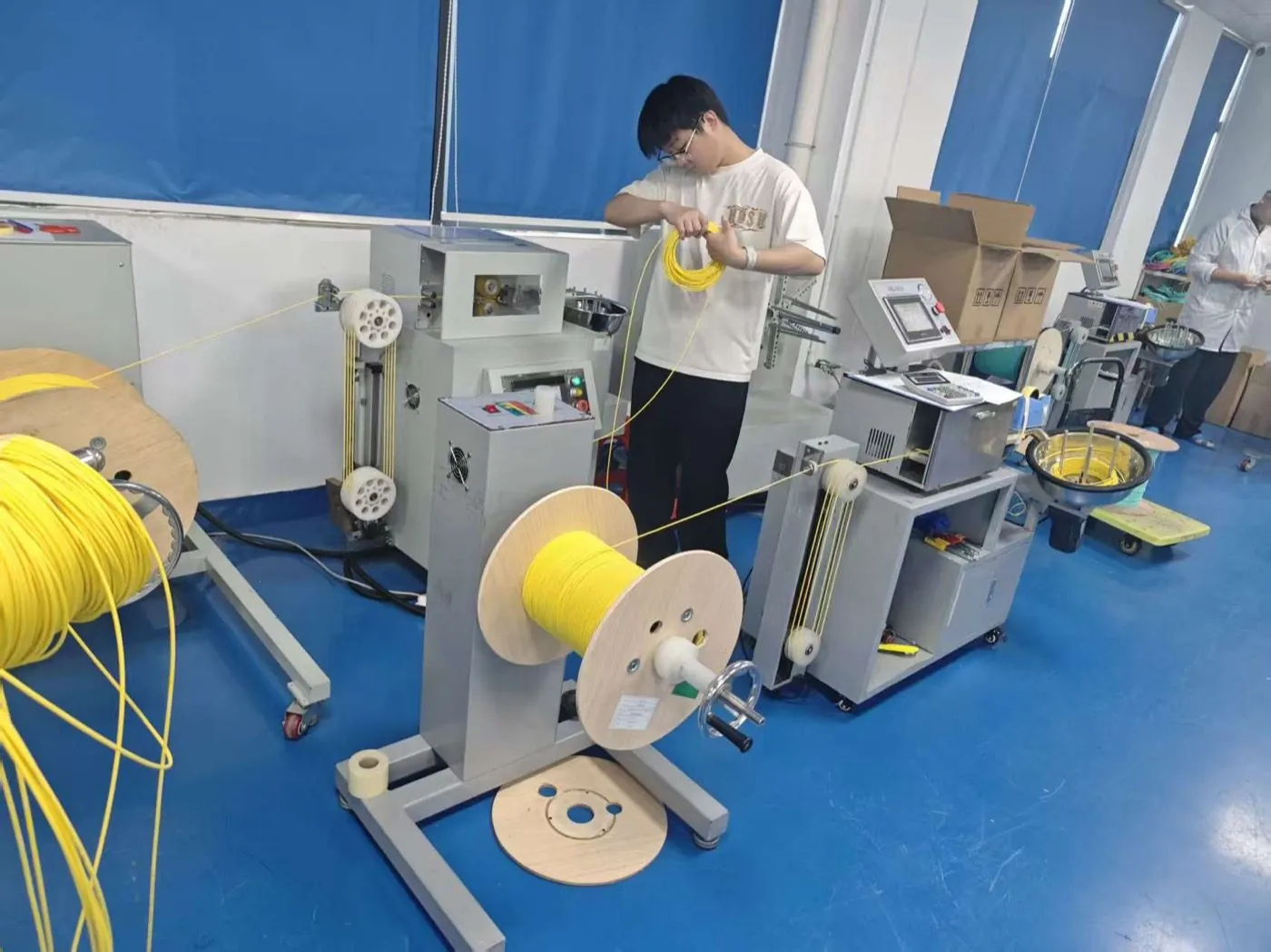
This article does not add product certifications, a minimum order, a lead time, or a supply commitment, and it does not add transceivers or media converters to the catalogue. Optical values for a cord or pigtail order are confirmed on the quotation and the test records.
FAQ
SFP wavelength and patch cord FAQs
Can I use the same patch cord for a 1310 nm SFP and a 1550 nm SFP?
A single-mode cord can carry either wavelength if the plant and the connectors match the module data sheet. The two modules are still different: in the Cisco examples opened for this article, 1000BASE-LX/LH and 1000BASE-EX are 1310 nm, and 1000BASE-ZX is 1550 nm, with different published reaches. Always match both ends to the same plan, and do not treat those reaches as universal.
Is every BiDi SFP a 1310/1550 nm pair?
No. The 1000BASE-BX10 pair in the Cisco data sheet, described as compatible with IEEE 802.3ah, is 1490 nm in one direction and 1310 nm in the other. Other BiDi products can use different wavelengths. Read the pair from the modules on the order; do not assume a blog “1310/1550” table applies.
Do I need a special patch cord for a BiDi SFP?
You need one strand of the fiber type the data sheet names, and a connector and polish that match the port. In the Cisco BX10 example that is standard SMF and a single LC/PC. You also need the complementary D and U modules. Lumafyn does not supply those modules, and a duplex jumper is not what a one-fiber port is asking for.
Can I use a multimode jumper on a 1310 or 1550 nm SFP?
Not if the data sheet names single-mode fiber. In the Cisco examples, 1000BASE-ZX and 1000BASE-EX are SMF, and 1000BASE-SX is multimode only. 1000BASE-LX/LH may run on multimode only with a mode-conditioning patch cord on legacy multimode, as that data sheet states. Follow the sheet for the modules in use.
Do the 10 km, 40 km or 70 km figures apply to every SFP?
No. Those are published operating distances in one Cisco data sheet, and the 70 km ZX figure is already written as approximate and loss-dependent. They are not Lumafyn ratings and they are not a promise for every vendor’s module.
Does Lumafyn supply the SFP or a media converter?
No. This guide is about matching the cord or pigtail to transceivers specified by others. We quote jumpers and pigtails from our own factory and issue test records for those assemblies.
Sources and Further Reading
Standards and public references describe definitions and industry practice; they are not Lumafyn product data. Optical values, MOQ and lead time for your order are confirmed in your quotation and test records.