
Buyer Guide · Southeast Asia
Pre-Terminated Drop Cable vs Fast Connector for FTTH
On the FTTH last drop — the cable between a distribution terminal and the subscriber — you can finish the ends in two ways. A pre-terminated drop cable leaves the factory with connectors already fitted and tested, so the crew pulls a cut length and plugs it in. A fast connector, also called a field-installable connector, is assembled on a bulk drop cable at the premises or at the terminal after the cable is cut to the span. This page compares those two methods so a planner can choose one, or use both on the same network. It is not a drop-cable buying guide and not a fast-connector installation manual; those already exist on this site. Optical values, MOQ and lead time are confirmed in your quotation and test records.
Published 2026-11-17 · Last reviewed 2026-11-17 · By the Lumafyn Technical Team
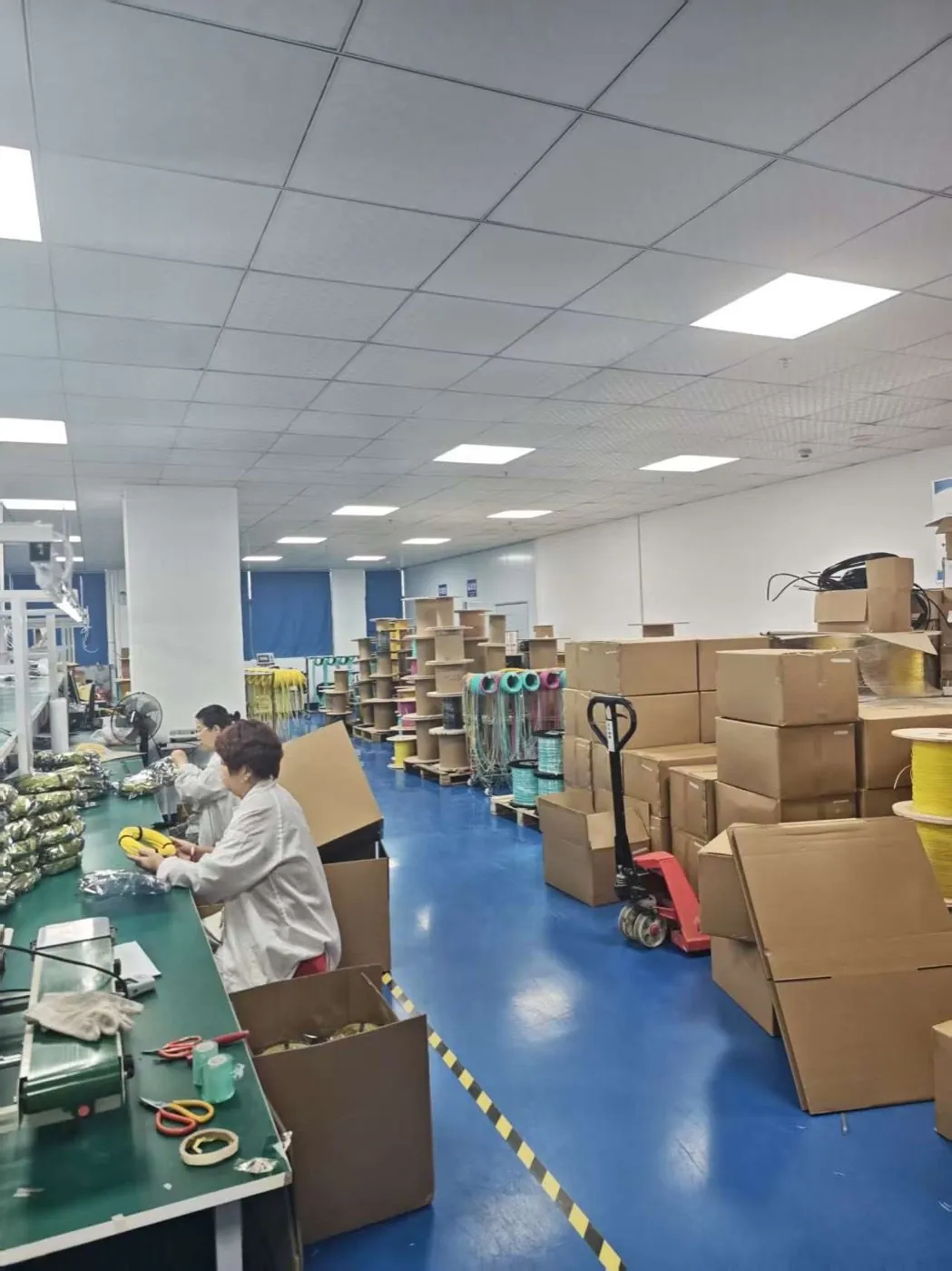
Lumafyn products are made at an ISO 9001 / ISO 14001 / ISO 45001 certified production base (management-system certificates issued by NOA). The certificates cover the production base, not individual products.
View certificates →Which Method Finishes the Last Drop
Pre-terminated drop cable vs a fast connector is a decision about where the last connector is made, not about which drop construction you buy. Both methods can use the same flat indoor, self-supporting aerial or round outdoor drop; the FTTH drop cable buying guide covers those constructions, including a short section on pre-terminated drops. This page takes the next step: when to factory-terminate the drop, and when to take a fast connector to the span.
The last drop sits after the distribution terminal — the box that different networks call a FAT, ODP, or similar name, as explained in FTTH box names — and before the ONT or a wall outlet. A materials view of the same link is in the GPON ODN materials list. Box bodies themselves are not a product listing on this site; name the terminal model you use so connectors match the port.
| Point | Pre-terminated drop cable | Fast connector on bulk drop |
|---|---|---|
| Where the connector is fitted | In the factory, on a cut length, then inspected and tested before packing | On site, on a drop cut from a reel, at the terminal, the wall outlet, or both |
| What the crew does | Select a planned length, pull or clip the cable, store slack, clean and mate the connectors | Route and cut the drop to the span, prepare the fiber, assemble the fast connector, then inspect and test |
| Tools on the visit | Pulling accessories if the route is in duct, a cleaner and an inspection scope or a power meter | A drop-prep tool kit, a cleaver (quality matters), the connector kit, plus inspection and test gear |
| Length planning | Lengths must be chosen in advance; too short cannot be fixed in the field; too long needs slack storage | The drop is cut to the span, so one reel covers many distances |
| Typical published loss (FOA, not a Lumafyn specification) | Factory-made single-mode connectors that are fusion spliced on are described by FOA as typically 0.1–0.2 dB. The factory also issues a test record for that assembly. | FOA describes pre-polished / mechanical splice-on connectors as often 0.5–0.7 dB at best, with techs commonly around 0.5 dB when a quality cleaver is used, still aiming to stay at or under the TIA-568 0.75 dB maximum acceptable connector loss. |
| Best fit | Planned urban or MDU routes with a known length set and little slack room at the terminal | Rural or irregular spans, repairs, and any route whose length is not known until the crew arrives |
Two Ways to Finish the Same Span
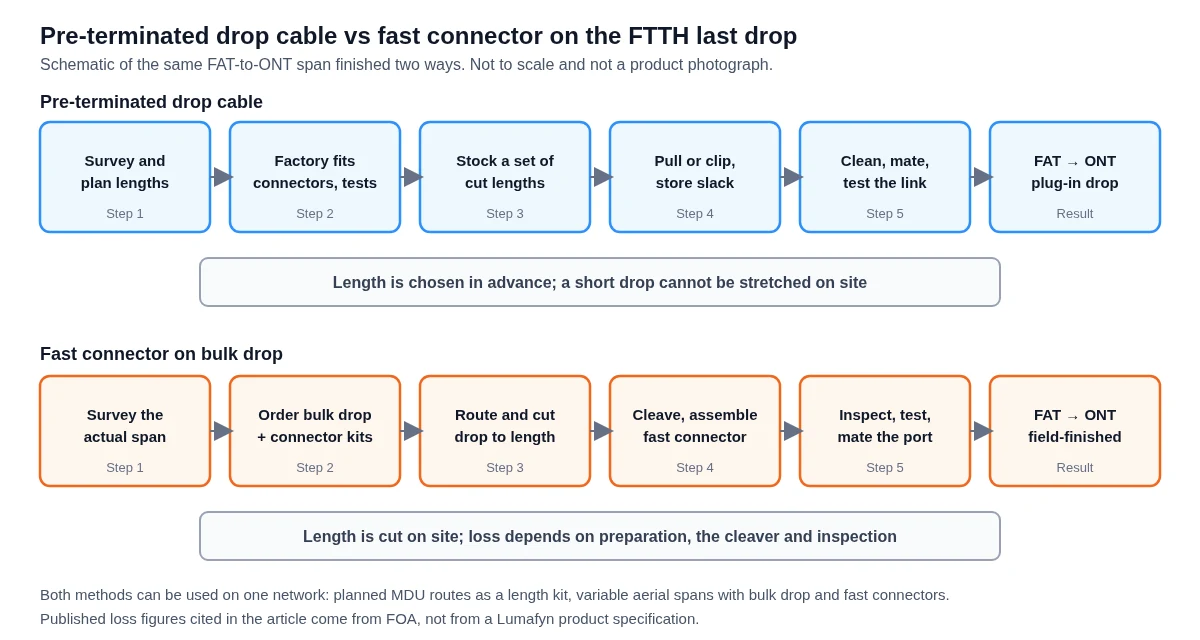
The diagram shows the same FAT-to-ONT span finished two ways. In the pre-terminated route, the factory fits the connectors, the crew pulls a stock length and stores slack. In the fast-connector route, the crew cuts bulk drop to the span and terminates on site. The comparison table above carries the same points as readable text, so the decision does not live only in the picture.
When a Pre-Terminated Drop Cable Is the Better Fit
A pre-terminated drop is the better fit when the length can be planned and the crew’s time at the subscriber should not include termination. The connector is polished and tested in the factory, and each cable can carry a serialised record that receiving and field supervisors can file. That is the same reason factory-made patch leads are used inside buildings: the process window is controlled before the visit.
- MDU risers and planned indoor routes where a short set of lengths (for example a few fixed metre lengths) covers most flats, and slack can be stored in the outlet or the floor box.
- Urban outdoor drops whose span distribution is already measured, so a length kit can be stocked in the depot.
- Projects that want to keep cleavers and splice-on kits off the subscriber visit, and to reduce the skill needed on each install.
- Drops that will be pulled in duct, provided you specify a pulling grip or a protective sleeve over the connector so the ferrule is not the pulling point.
The constraint is length. A pre-terminated drop cannot be shortened without becoming a different product (you would be cutting off a tested connector and fitting another). A drop that arrives long needs a designed slack store. The buying guide already flags “pre-terminated lengths guessed” as a common mistake; this comparison is why that mistake is expensive.
Write the connector to match the port. SC/APC is common on indoor FTTH ends. Outdoor terminals that use a hardened or sealed port need that interface named explicitly. Do not assume a standard SC will mate with a hardened terminal.
When a Fast Connector Is the Better Fit
A fast connector is the better fit when the span is not known until the crew is on site, or when the network would have to stock too many pre-terminated lengths. The crew cuts bulk drop from a reel, prepares the fiber, and assembles a field-installable connector. Our field-installable connector guide covers mechanical versus splice-on types, cable match and tools; this page only places that choice against factory pre-termination.
- Rural or suburban aerial spans that vary from house to house.
- Repairs and cut-overs, where a damaged pre-terminated end would otherwise force a whole new cut length from the depot.
- Mixed plant that already has bulk drop on reels and needs a connector kit that matches that cable’s cross-section (flat or round, and the coating diameter).
- Builds that accept a trained crew and a cleaver kit in exchange for simpler inventory.
The constraint is process control. FOA’s page on pre-polished / splice-on connectors describes a factory-quality ferrule whose connector-to-connector interface can average better than 0.2 dB, but the mechanical or fusion splice behind the ferrule can add 0.3–0.5 dB, making a 0.5–0.7 dB termination at best, with technicians often around 0.5 dB when they use a quality cleaver. FOA also notes that a simpler cleaver is associated with higher losses, more often around the 0.75 dB TIA-568 maximum acceptable value. Those figures are FOA’s published industry figures, not Lumafyn product specifications, and they assume the connector is matched to the cable and then inspected.
Time on site can still be short. FOA describes mechanical pre-polished termination as “terminate a fiber in less than one minute” once the fiber is prepared. Preparation, inspection and testing are extra, and they are the steps that decide whether a fast connector is actually faster than unpacking a pre-terminated length.
Loss, Inspection and What to Count in the Budget
Count the joints that actually sit in the last drop, then apply the limits in your network design — not a generic “typical” number from a brochure. FOA’s loss-budget page is the public reference used here:
- Factory-made single-mode connectors that are fusion spliced on: typically 0.1–0.2 dB (FOA).
- Typical adhesive/polish connector value in FOA’s worked example: 0.3 dB; TIA-568 maximum acceptable connector loss: 0.75 dB.
- Pre-polished / mechanical field connectors: FOA’s 0.5–0.7 dB “at best” band, with many technicians around 0.5 dB with a quality cleaver.
- Single-mode fusion splices (relevant if a splice-on connector or a pigtail is used instead of a mechanical fast connector): typically less than 0.05 dB (FOA).
A pre-terminated drop that is mated at both ends contributes two factory connectors plus any adapters at the terminal and the ONT. A bulk drop with a fast connector at one end and a factory connector or another fast connector at the other end contributes whatever you actually fitted. Write that count into the link budget with the rest of the ODN (splitter, splices, distribution fiber), which the PLC splitter ratio guide and the GPON materials list help you lay out.
In both methods, clean and inspect the end face before you mate it. A dirty factory connector can measure worse than a carefully made field connector. Acceptance limits for a shipment of pre-terminated drops, or for a field-terminated sample, belong in the project specification and the quotation.
Inventory, Labour and Using Both Methods on One Network
The two methods pull inventory in opposite directions. Pre-terminated drops move variety into the depot (a set of lengths, each with its own quantity). Fast connectors move variety into the tool bag (connector kits and cleavers) and keep the cable as bulk reels. Labour moves the other way: pre-termination spends time in the factory and saves time at the house; fast connectors spend time and skill at the house and save planning time in the office.
Many Southeast Asian FTTH builds use both. A city MDU package can be a length kit of pre-terminated indoor drops plus a small stock of fast connectors for odd floors and repairs. A provincial aerial package can be bulk self-supporting drop plus SC/APC fast connectors, with a few pre-terminated lengths reserved for standard short leads at the terminal. That mix is a planning choice; it is not a requirement to buy any particular accessory from this site.
What to Put on the RFQ for Each Method
Keep pre-terminated drops and fast connectors on separate lines, even when they ship together with bulk drop.
| Field | Pre-terminated drop line | Fast-connector line (with bulk drop) |
|---|---|---|
| Cable construction | Route type, fiber count and type (often 1 or 2 fibers, G.657.A1 or A2), strength member, jacket — see the drop buying guide | Same construction fields on the bulk-drop line, so the connector kit matches the cable |
| Connectors | Interface and polish on each end (for example SC/APC to SC/APC), or one end only if the other is left bare | Interface and polish (for example SC/APC), mechanical or splice-on type if you have a preference, and the cable cross-section it must fit |
| Length | Each stock length and the quantity per length; slack storage assumed at the site | Reel length for the bulk drop; connector quantity, not a cable length |
| Pulling protection | Grip or sleeve if the assembly will be pulled in duct | Usually not applicable on the connector line |
| Test records | IL and RL per connector, serialised to the cable label, plus the inspection method you require | The field-test method the crew will use (and any sample factory data on the connector kit itself) |
Mark open fields “to be confirmed”. Fast connectors and drop cable are existing product lines; FAT, ODP and similar housings are not listed as products here, so name the terminal port rather than asking this site for a box model. Southeast Asian buyers who want one conversation for the passive FTTH kit can start from the Southeast Asia fiber optic supplier page and attach both line types. Product pages for the two methods are FTTH drop cable and fast connectors and FTTH accessories.
FAQ
Pre-Terminated Drop Cable vs Fast Connector FAQ
What is the difference between a pre-terminated drop cable and a fast connector?
A pre-terminated drop cable is cut to a planned length and fitted with connectors in the factory, then pulled and plugged in on site. A fast connector is a field-installable connector assembled on bulk drop cable after the crew cuts the span. Both can finish the same FAT-to-ONT drop.
Which method has lower loss?
Factory-made connectors are described by FOA as typically 0.1–0.2 dB for fusion-spliced single-mode terminations. FOA describes pre-polished field connectors as often around 0.5 dB, and 0.5–0.7 dB at best, against a TIA-568 maximum acceptable connector loss of 0.75 dB. Those are FOA figures, not Lumafyn specifications. Count the actual joints in your drop and apply your network’s limits.
Can one FTTH project use both methods?
Yes. Planned MDU or urban routes often use a pre-terminated length kit, while variable aerial spans and repairs use bulk drop plus fast connectors. Keep the two products on separate RFQ lines and match both to the same fiber type and polish.
Does a pre-terminated drop replace the need to choose a drop construction?
No. Indoor flat, aerial figure-8 and round outdoor drops are still chosen by the route, as the drop cable buying guide explains. Pre-termination is an end finish applied to that construction.
What do you need to quote these items?
For pre-terminated drops: construction, connectors and polish on each end, each length and quantity, pulling protection if needed, and test records. For fast connectors: the interface, the cable cross-section they must fit, and quantity, plus a separate bulk-drop line. Optical values, MOQ and lead time are confirmed in the quotation and test records.
Sources and Further Reading
- FOA: splice-on and pre-polished connectors (field termination time, 0.2 dB / 0.3–0.5 dB / 0.5–0.7 dB discussion, TIA-568 0.75 dB)
- FOA: loss budget (typical factory single-mode 0.1–0.2 dB, typical adhesive/polish 0.3 dB, TIA-568 max 0.75 dB, fusion splice <0.05 dB)
- FOA: outside-plant termination (pigtails, field connectors and process notes)
- FOA: FTTH architecture (where the last drop sits in the access network)
- FOA: Fiber to the home overview
- ITU-T G.657 (bend-insensitive single-mode fiber commonly specified on FTTH drops)
Standards and public references describe definitions and industry practice; they are not Lumafyn product data. Optical values, MOQ and lead time for your order are confirmed in your quotation and test records.