
Buyer Guide · Europe
Pre-Terminated Fibre vs Field Termination: Time, Loss and Cost Compared
Pre-terminated fibre arrives with connectors already fitted, polished and tested in a factory, so installers pull it and plug it in. Field termination means fitting connectors or splicing pigtails on site after the cable is pulled. Pre-terminated fibre usually cuts on-site time and gives you factory test records for every fibre; field termination copes better with unknown routes, tight ducts and last-minute changes. Loss per connection is similar when both are done well, but the number of connection points differs.
Published 2026-11-15 · Last reviewed 2026-11-15 · By the Lumafyn Technical Team
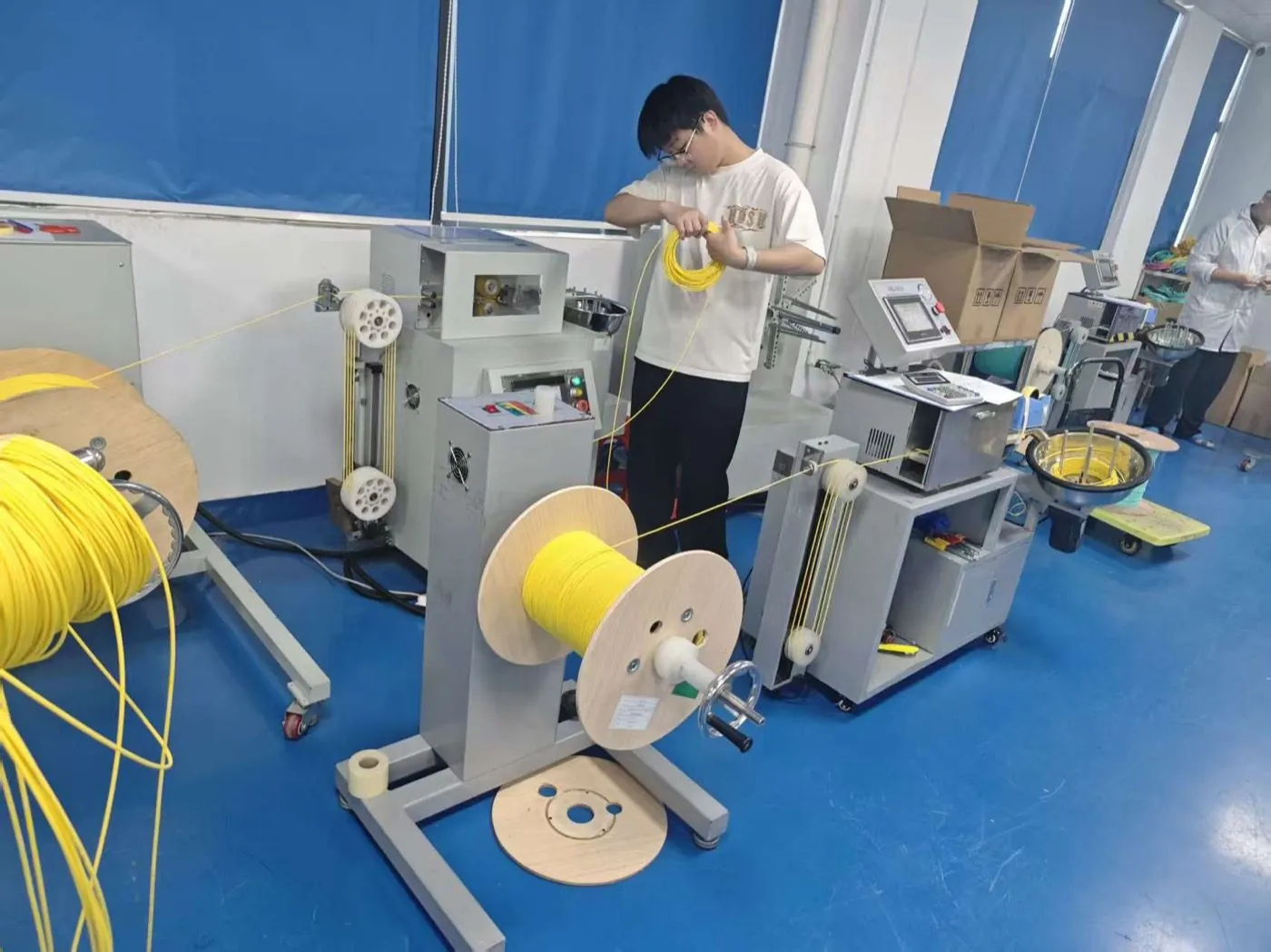
Lumafyn products are made at an ISO 9001 / ISO 14001 / ISO 45001 certified production base (management-system certificates issued by NOA). The certificates cover the production base, not individual products.
View certificates →Pre-Terminated Fibre vs Field Termination at a Glance
The main difference is where the termination work happens: in a factory before delivery, or on site after the cable is installed. Everything else in the comparison, from labour hours to test evidence, follows from that one choice.
| Factor | Pre-terminated fibre | Field termination |
|---|---|---|
| Where connectors are fitted | In the factory, before shipping | On site, after the cable is pulled |
| Skills and tools on site | Cable pulling, cassette or panel fitting, cleaning and testing | Stripping, cleaving, fusion or mechanical splicing, splice tray management, cleaning and testing |
| Time on site | Short: the termination work has already been done | Longer: every fibre is terminated in place |
| Loss per connection point | Factory-polished connectors, typically about 0.3 dB per mated pair (FOA) | Connector loss plus the splice that attaches it (FOA) |
| Number of connection points | Can rise if MPO cassettes are added at each end | Splices are added, but no MPO-to-LC transitions |
| Length risk | Must be measured before ordering; spare length is stored as slack | Cut to length on site |
| Test evidence before install | Factory insertion loss and end-face records | None until the installer terminates and tests |
| Best fit | Data centres, comms rooms, repeatable fit-outs, short programmes | Outside plant, unknown routes, repairs, small ducts |
What Pre-Terminated Fibre Means
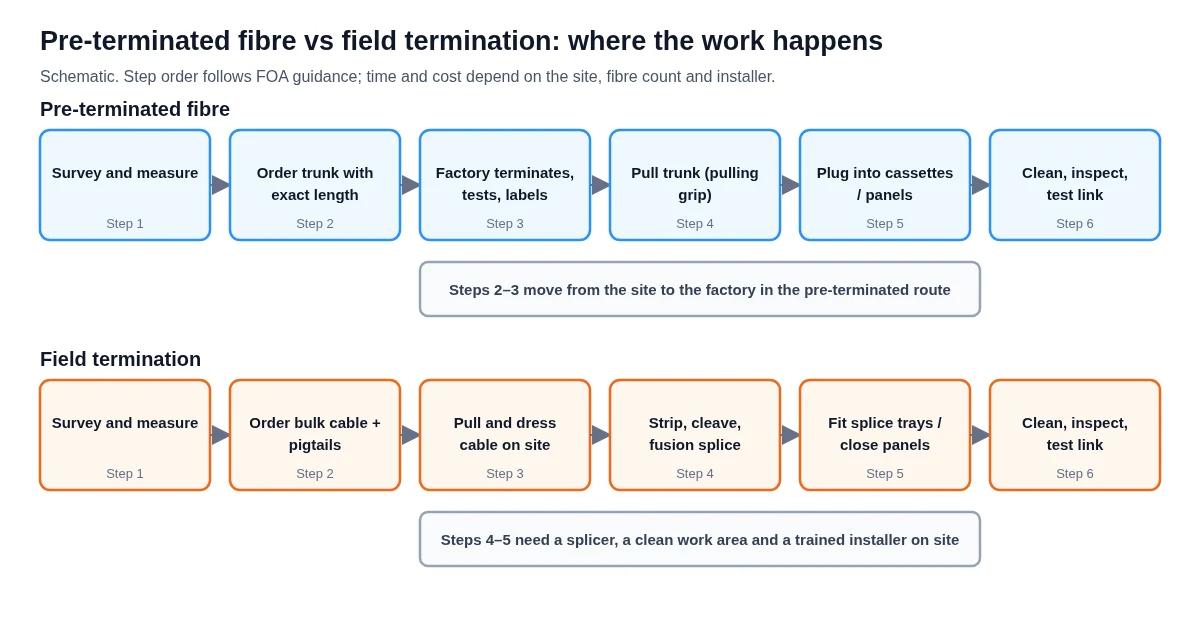
Pre-terminated fibre is cable cut to an ordered length and fitted with connectors, polished and tested before it leaves the factory. In structured cabling it usually takes the form of trunk cables between racks or rooms, terminated with LC or MPO connectors and often protected by a pulling grip for the pull.
MPO connectors are built for exactly this job. The FOA connector identifier notes that the main use of the MPO is preterminated cable assemblies and cabling systems, because one array connector carries 12 or 16 fibres in a row. A typical data centre link then runs MPO trunk, cassette or breakout, and short LC fibre patch leads (a fiber patch cord in US catalogues) to the equipment. See our MPO/MTP trunk cables and MPO to LC breakout cables for the assemblies we build in our own factory.
- Trunk cable: the backbone between two panels, with connectors on both ends.
- Cassette or breakout: converts MPO to LC at the panel; see MPO breakout vs harness vs cassette.
- Pulling grip: a sleeve over the connectors so the cable can be pulled without loading the ferrules.
What Field Termination Means
Field termination means the installer fits the connectors after the cable is in place, using one of three methods. Each method trades speed, tools and loss differently.
- Splicing factory-made pigtails. The installer fusion splices a pigtail with a factory-polished connector onto each fibre. FOA guidance says most field singlemode terminations are made this way rather than by polishing on site (FOA).
- Splice-on and prepolished/splice connectors. A factory-polished stub inside the connector is joined to the fibre by a fusion or mechanical splice. FOA describes mechanical versions that terminate a fibre in less than one minute, and fusion versions that take no longer than a fusion splice (FOA).
- Adhesive and polish. The fibre is glued into the connector and polished by hand. The FOA installation guide notes that multimode connectors are generally installed directly in the field, while singlemode is more often spliced to pigtails (FOA).
The splice that attaches a connector counts as part of the connection. FOA points out that the loss of a spliced-on termination is the connector loss plus the splice loss, which matters when you compare it with a factory-terminated trunk.
Time on Site: Where Pre-Terminated Fibre Saves Hours
Pre-terminated fibre saves time on site because the stripping, splicing and tray work has already been done in the factory. The installer pulls the trunk, removes the pulling grip, plugs the connectors into the panel and tests.
That saving is largest where many fibres end in the same room, such as a data hall or a comms room serving several floors. It is smallest on long single runs with few fibres, where a field team would only make a handful of splices anyway.
- Programme risk moves earlier. The time saved on site depends on measuring routes accurately before ordering, and on the factory lead time, which is confirmed in your quotation.
- Fewer specialist tools on site. A fusion splicer and a clean splicing area are not needed for the trunk itself, although a test set and an inspection scope still are.
- Less disruption in live rooms. Splicing creates fibre offcuts and needs a bench; plugging in a trunk does not.
Loss: How Many Connections Are in the Link?
For loss, what matters is how many connection points the link contains, not whether the connectors were fitted in a factory or on site. Count every mated pair and every splice, then compare the total with the equipment budget.
The FOA loss budget guide uses 0.75 dB as the TIA-568 maximum for a mated connector pair and 0.3 dB as a typical value for adhesive/polish connectors. It allows up to 0.3 dB per splice and notes that singlemode fusion splices are typically below 0.05 dB. Using the maximum values, three common singlemode designs compare like this:
| Design | Connection points | Maximum loss |
|---|---|---|
| Pre-terminated LC trunk into LC panels at both ends | 2 mated pairs | 2 x 0.75 = 1.5 dB |
| Field-spliced pigtails at both ends | 2 mated pairs + 2 splices | 1.5 + 2 x 0.3 = 2.1 dB |
| Pre-terminated MPO trunk with MPO-to-LC cassettes at both ends | 2 MPO pairs + 2 LC pairs | 4 x 0.75 = 3.0 dB |
These are ceilings from the standard, not what a good installation measures. They show the trap in cassette-based designs: two extra mated pairs per link. If the transceiver budget is tight, specify low-loss connectors and ask for the measured values per fibre. For Lumafyn assemblies, insertion loss values are confirmed in your quotation and test records. If you have not read a factory report before, our guide on how to read a patch cord test report explains each column.
Cost: Material, Labour and Rework
Pre-terminated fibre costs more per metre as material but usually less as an installed link, because labour, tools and rework fall. Whether the total is lower depends on how many fibres you terminate in one place and how much site time costs.
- Material: a factory assembly includes connectors, polishing, testing and labels; bulk cable plus pigtails is cheaper to buy.
- Labour: field termination needs a splicing team for every fibre end; pre-terminated fibre needs a pulling and patching team.
- Tools: fusion splicers, cleavers and splice closures are needed for field work.
- Rework: a bad field splice is redone on site; a damaged trunk connector usually means a repair or a replacement assembly.
- Slack: pre-terminated lengths are ordered with spare length, which needs space in trays or slack boxes.
We do not publish price lists, because cost depends on fibre count, connector type, length and quantity. Send the link schedule and we confirm prices in your quotation.
When Field Termination Still Makes Sense
Field termination is still the better choice when the route or the length cannot be known in advance. In those cases, a cable that is cut and terminated on site avoids ordering assemblies that do not fit.
- Outside plant and long campus runs, where cables are spliced in closures anyway.
- Routes through small ducts or fire-stopped penetrations where a pulling grip will not pass.
- Repairs and moves, adds and changes in an existing building.
- Projects where the drawings are still changing and lengths are not frozen.
- FTTH drops, where a different set of choices applies; see our FTTH drop cable guide and field-installable connector guide.
Many projects mix the two: pre-terminated trunks inside the data hall and spliced backbone or outside plant cable between buildings.
How to Specify a Pre-Terminated Fibre Trunk
A pre-terminated fibre order needs every dimension and connector fixed before production, because nothing is cut on site. Use this list when you write the RFQ.
- Fibre type: OS2, OM4 or OM3, and the fibre count per trunk.
- Connectors at each end: MPO (pinned or unpinned) or LC, with UPC or APC polish; see APC vs UPC.
- Polarity: Method A, B or C, matched to the cassettes and patch leads; see the MTP/MPO polarity guide.
- Length: measured route length plus slack at each end, and breakout leg length if the ends fan out.
- Pulling end: pulling grip on one or both ends, and the outer diameter it must pass through.
- Sheath: indoor LSZH or another sheath, and the CPR Euroclass your project requires; see the CPR Euroclass guide.
- Labels: trunk ID, end A and end B, and the panel and port at each end.
- Test records: insertion loss per fibre and end-face inspection, delivered with the order.
| Field | Example |
|---|---|
| Project | Data centre fit-out, cabling contractor in the Netherlands |
| Trunks | 8 x 24-fibre OS2 MPO trunks, Method B |
| Lengths | Per link schedule, plus slack at both ends |
| Ends | Pulling grip on end A; cassettes at both ends quoted separately |
| Patch leads | LC duplex OS2 patch leads for the equipment side |
| Price, MOQ, lead time | Confirmed in your quotation |
For how we work with buyers in the UK, Germany, the Netherlands and the rest of Europe, see fibre optic supply for Europe.
Testing and Acceptance for Both Methods
Both methods need the installed link tested and the end faces inspected before handover. Factory test records prove the assembly was good when it shipped; they do not replace a test after pulling and patching.
- Inspect and clean every connector before mating; dirt is the most common cause of high loss. For MPO, see how to inspect and clean MPO/MTP connectors.
- Measure insertion loss of the installed link and compare it with the calculated budget from the FOA method.
- Keep the factory records and the site results together, so a later fault can be traced to the assembly or to the installation.
FAQ
Pre-Terminated Fibre FAQ
Is pre-terminated fibre lower loss than field termination?
Not by default. A factory connector and a well-made fusion splice both add little loss. What changes the total is the number of connection points, and MPO cassettes add two mated pairs per link.
Is pre-terminated fibre cheaper?
Usually as an installed link, not as material. It costs more per metre to buy but saves splicing labour, tools and rework on site. The result depends on fibre count and labour rates.
Can pre-terminated fibre be shortened on site?
Not without re-terminating at least one end, which removes the benefit. Order the measured length plus slack, and store the spare in trays or slack boxes.
Do pre-terminated trunks still need testing after installation?
Yes. Factory records show the assembly was good when it shipped. Test the installed link and inspect the end faces before handover.
What should a pre-terminated trunk RFQ include?
Fibre type and count, connectors and polish at each end, polarity method, lengths with slack, pulling grip, sheath and Euroclass, labels and the test records you need.
Sources and Further Reading
- Fiber Optic Association: network loss budget (connector and splice loss values)
- Fiber Optic Association: splice-on and prepolished/splice connectors
- Fiber Optic Association: outside plant splicing and termination
- Fiber Optic Association: installation guide (PDF)
- Fiber Optic Association: connector identifier (MPO)
Standards and public references describe definitions and industry practice; they are not Lumafyn product data. Optical values, MOQ and lead time for your order are confirmed in your quotation and test records.